Related: Kamado Vent Control: How to Hold 250 Degrees All Night
I have cooked on a $4,000 ceramic egg and on a $200 hardware-store egg, and the difference was never the logo. It was the ceramic, the gasket, and whether the thing could hold 250 degrees while a Savannah thunderstorm rolled through. This ceramic kamado grill comparison is about the one decision that changes how you actually cook: size.
A 24-inch kamado and a 15-inch kamado are not the same tool at different prices. One is a commitment to a cooker that lives on your patio for fifteen years. The other is a weeknight machine that fits beside the garage door. Both are legitimate. Buying the wrong one is how people end up with a $1,500 grill they use twice a summer, or a small egg they outgrow in a season and resent.
So here is the honest breakdown of the four cookers on this list, sorted by what they are for, not by what the marketing copy says.
Kamado Joe Big Joe Series III, Standalone
The word that matters in this listing is "standalone." There is no cart in the box. That is not a knock, it is the point. If you already own a table, a nest, or a built-in island on the patio, you are not paying a second time for wheels and side shelves. You are buying 24 inches of ceramic and setting it where you want it.
Twenty-four inches is the size I tell people to buy if they are serious. It is the difference between cooking a brisket and cooking a brisket with a pork butt on the far side of the grate, running two different zones, and not playing Tetris with your food at hour nine. It is also the size where heat soak matters most. A big ceramic mass takes 30 to 45 minutes to stabilize, and once it does, it holds like a bank vault. Skip the soak on a cooker this size and you will chase temperatures all afternoon.
This is the flagship of the four, and it is priced like one. What you are paying for is the 24-inch class and the brand behind it. If you are the kind of cook who wants the biggest dome on the patio and a warranty that the company stands behind, this is the one to look at first. 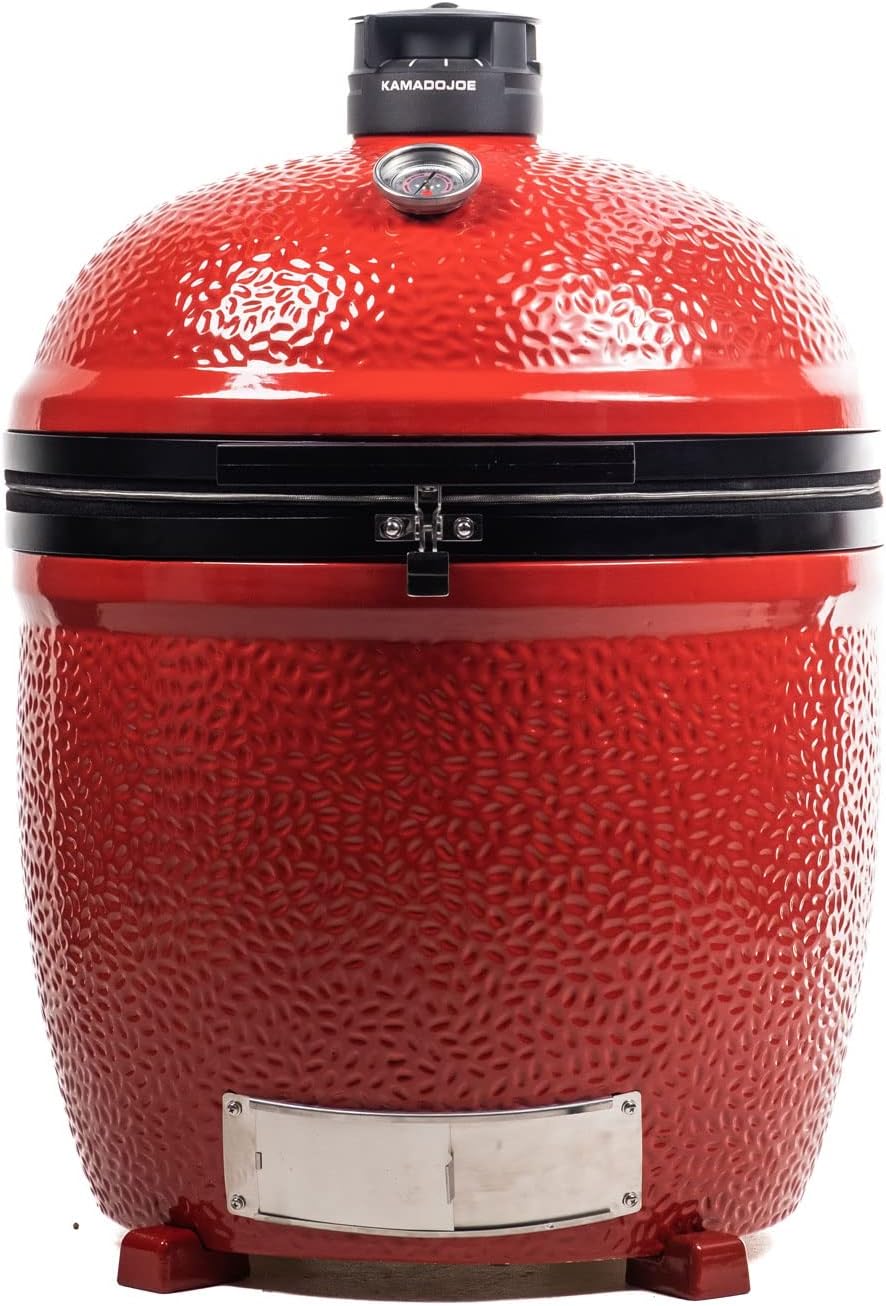 Visit on Amazon →.
Kamado Joe Big Joe Series I With Cart
Same 24-inch class, different package. This one arrives with the cart, the side shelves, and stainless steel grates, and it is listed at 450 cooking square inches. If you do not have a table and you do not want to build one, this is the version that is ready to roll on day one. In red, which matters if the patio has a color scheme and matters a great deal if it does not.
Here is the practical read. Between the standalone Series III and this Series I with the cart, the ceramic class is the same. What changes is the furniture around it and the generation of the hardware. If your budget is fixed and you want the 24-inch cook, the cart version is the sensible way in. You get the shelves for a plate of ribs coming off the grate, you get the wheels for moving it out of the weather, and you get the same size cook.
What I would check on any kamado in this class, cart or no cart: the gasket seal around the lid, the thickness of the ceramic at the rim, and the warranty language on the firebox. The firebox will crack eventually. That is not a brand problem, it is a ceramic problem, and the only question that matters is whether the replacement shows up without a fight. 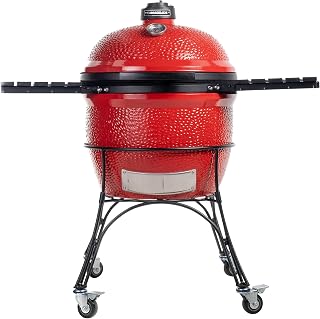 Visit on Amazon →.
London Sunshine 15-Inch Ceramic Kamado, Black
Now we are in a different category entirely. Fifteen inches is a weeknight cooker. It is the one you light on a Tuesday because it heats faster, uses less charcoal, and does not demand that you plan your whole afternoon around a heat soak.
The package here is genuinely practical for a small patio: locking casters so it does not wander while you are working the vents, foldable side shelves so it fits against a wall when it is parked, stainless steel grates, and a tall stand that puts the dome at a working height instead of at your ankles. That last part is underrated. A kamado on a low stand turns every cook into a squat workout.
What a 15-inch grate will do: a spatchcocked chicken with room to spare, a pork butt for a small crowd, steaks for four, ribs trimmed to fit, corn and vegetables beside the protein. What it will not do: two packer briskets, a full turkey with sides, or anything where you need two distinct heat zones running at once. Buy it for the meals you actually cook on a weeknight, not for the one party you host in July. 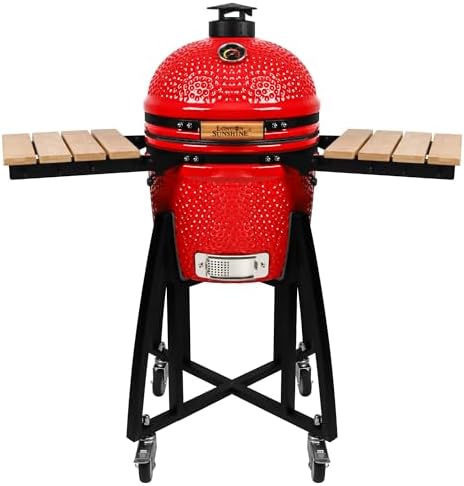 Visit on Amazon →.
London Sunshine 15-Inch Ceramic Kamado, Orange
This is the same 15-inch London Sunshine cooker in orange instead of black. Same locking casters, same foldable side shelves, same stainless steel grates, same tall stand. If you are comparing the two listings line by line looking for a mechanical difference, there is not one to find in the names.
So treat this as a finish decision. Orange sits loud on a patio and disappears against nothing. Black sits quiet and hides ash smudges better. Neither color changes how the ceramic holds heat, and anyone who tells you otherwise is selling something. Pick the one that makes you want to walk outside and light it, because the kamado you actually use beats the kamado you admire. 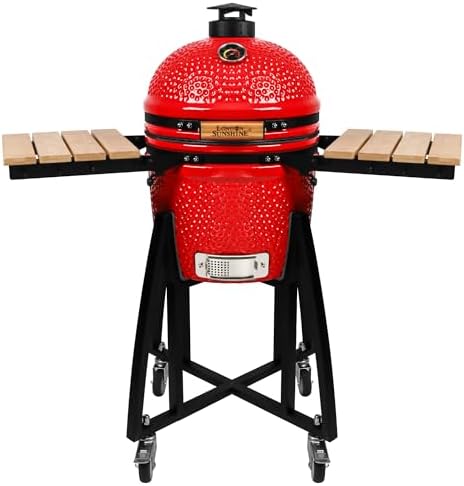 Visit on Amazon →.
The kamado reference table
This is the table I keep in my head when somebody asks me what to buy. Cooking class first, package second, purpose third. Nothing here is a substitute for reading the warranty before you order.
| Kamado | Class | What comes with it | Best for |
|---|---|---|---|
| Visit on Amazon → Kamado Joe Big Joe Series III Standalone Visit on Amazon → |
24-inch ceramic | Grill only, no cart | Cooks with a table or nest already, biggest dome, long low-and-slow sessions |
| Visit on Amazon → Kamado Joe Big Joe Series I Visit on Amazon → |
24-inch ceramic, 450 cooking square inches | Cart, side shelves, stainless steel grates | The 24-inch cook who wants it rolling out of the box |
| Visit on Amazon → London Sunshine 15-inch Kamado, Black Visit on Amazon → |
15-inch ceramic | Locking casters, foldable side shelves, stainless steel grates, tall stand | Weeknight cooking for two to four, small patios |
| Visit on Amazon → London Sunshine 15-inch Kamado, Orange Visit on Amazon → |
15-inch ceramic | Locking casters, foldable side shelves, stainless steel grates, tall stand | Same cooker as the black one, louder finish |
How I judge a kamado before I trust it with a brisket
My protocol does not change based on the brand. It is the same four questions every time, and I ask them before I ever think about the price.
First, does it hold temperature through weather? Not on a calm 72-degree evening. Through a storm, with wind pushing on the dome and rain coming in sideways. That is when a thin gasket and a cheap hinge show themselves, and that is when you find out whether your vents are actually sealing or just pretending to.
Second, is the ceramic thick enough to matter? Two cookers at the same size can be very different pieces of clay. Thicker walls mean slower temperature swings and better fuel economy on a twelve-hour cook. You can feel the difference at the rim with your hand. A thin rim flexes the conversation in your head toward "how long until this cracks."
Third, does the warranty cover the firebox without a fight? The firebox is the ceramic bowl that holds the charcoal. It cracks. It is not a matter of if, it is a matter of when, and the only thing that separates a good purchase from a bad one is whether the replacement part arrives without a notarized confession and three phone calls.
Fourth, would I trust it with a $90 brisket? That is the real test. Twelve hours, one piece of meat, no babysitting beyond the vents. If I would not put a packer on it overnight, it is not a kamado I recommend.
And one thing I say every time: learn your vents before you buy a temperature controller. A controller is worth it for overnight cooks. It is not a substitute for understanding your top and bottom vent. Guys who never learn the vents spend the first rainstorm of the season staring at an app while their fire runs away.
What the comparison actually comes down to
The gap between these four is not quality, it is size and package. Two are 24-inch ceramic cookers built for long cooks and crowds. Two are 15-inch ceramic cookers built for weeknights and small patios, and they differ only in finish.
Buy the 24-inch if your cooking is events. Holidays, football Saturdays, two butts at once, a brisket you start at midnight. Buy the 15-inch if your cooking is dinner. Chicken on a Tuesday, steaks on Friday, a small pork butt on a lazy Sunday. Buy the standalone 24 if you have a table. Buy the cart version if you do not. Buy the black 15-inch if you want it to disappear into the corner. Buy the orange one if you want the neighbors to know.
The mistake I see most is a guy buying the biggest dome he can afford and then never lighting it because a twelve-hour cook feels like a production. The second most common mistake is buying small for the patio and then discovering that the one meal you actually host every year will not fit. Be honest about which cook you are. That answer picks the grill for you.
Should you buy the Kamado Joe Big Joe Series III standalone?
If you have a table, a nest, or a built-in spot, yes. It is the 24-inch class without the furniture tax. You get the big dome, the long heat soak, and the room to run a packer brisket with a pork butt parked beside it. What you do not get is a cart, and if that is a dealbreaker, look at the Series I instead. Buy this one when the patio is already set up and you want the biggest cook.
Should you buy the Kamado Joe Big Joe Series I with cart?
This is the one for the cook who wants 24 inches and does not want to build anything. Cart, side shelves, stainless steel grates, 450 cooking square inches, and a red finish that announces itself. Same ceramic class as the standalone, ready to roll on day one. If your budget only stretches to one 24-inch kamado and you have no table, this is the sensible pick.
Should you buy a London Sunshine 15-inch kamado?
Yes, if you are cooking for two to four and you want a kamado you will actually fire up on a weeknight. Locking casters, foldable shelves, stainless steel grates, and a tall stand make it a genuinely usable small cooker rather than a novelty. The black and the orange are the same grill, so pick the color and stop agonizing. Just do not buy it expecting to feed a holiday crowd. Fifteen inches is a weeknight tool, and it is a good one.