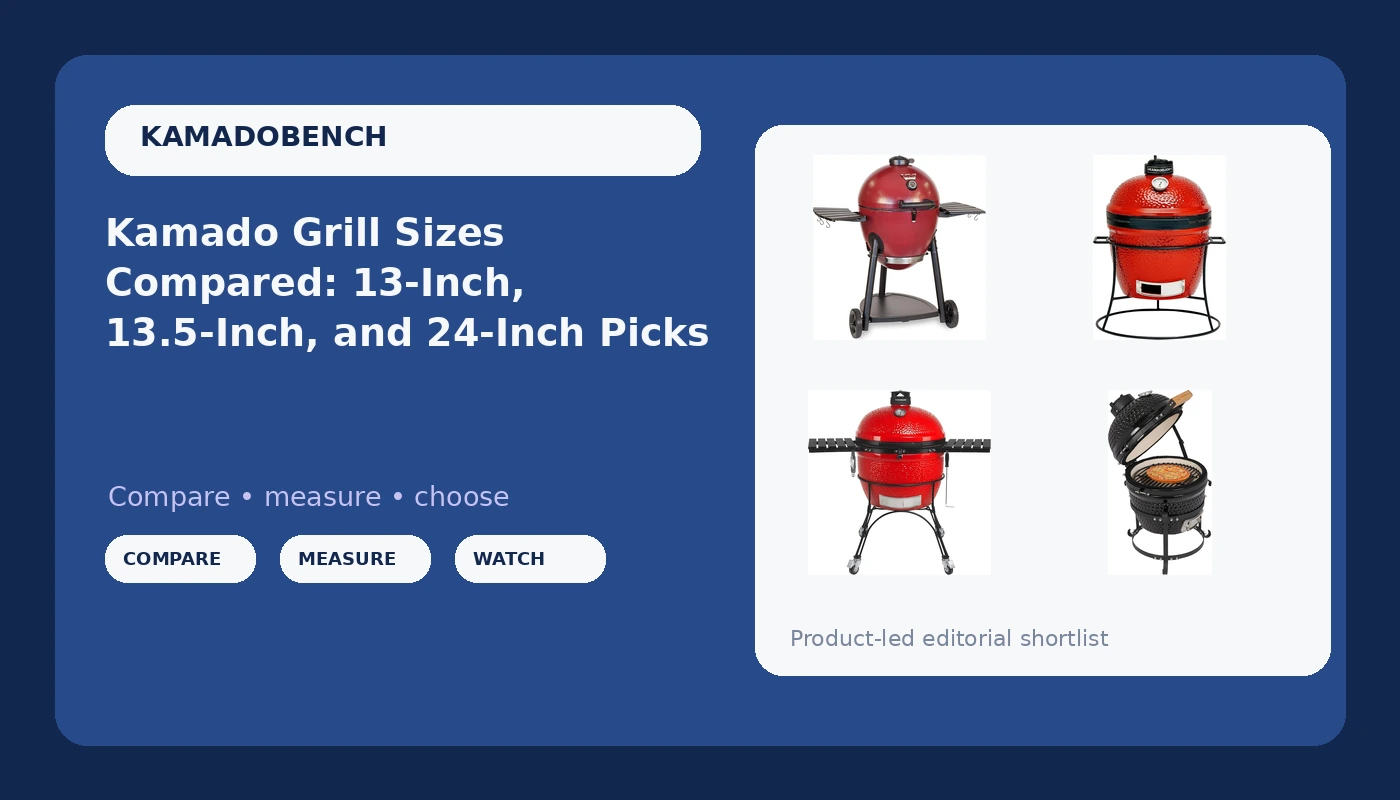
Kamado grill sizes are the first decision that actually matters, and they are the one most shoppers get backwards. A 13-inch ceramic egg and a 24-inch ceramic egg run on the same physics: thick walls, a sealed lid, and vents you set by hand. What changes is how much meat fits, how much charcoal it takes to reach temperature, and whether you are cooking for two on a Tuesday or a crowd on a Saturday. Buy too small and you will run two cooks back to back. Buy too large and you will spend fuel heating empty space. This explainer walks through four current options across three sizes and one steel-bodied design, and it lays out what each one is actually for.
Related: How to Hold 250 Degrees Through a Georgia Thunderstorm →
Quick answer
Match the cooker to the cook, not to the photograph. A 13-inch kamado is a compact ceramic for two to four people and small cuts. A 13.5-inch portable ceramic adds a stand, a stainless steel grate, and heat deflectors, which makes it a more complete small cooker. A 24-inch kamado with 450 cooking square inches is what you buy when you plan on packer briskets, multiple pork butts, or a holiday spread. The Char-Griller Akorn is the budget route into kamado-style cooking without a ceramic shell. None of these is universally the right answer; the deciding factors are how many people you feed and how often you light it.
Four useful options
| Model | Best fit | What stands out |
|---|---|---|
| Outvita Ceramic Grill, 13" Round Kamado Charcoal Grill, Black | Small households, balconies, and tight patios | 13-inch round ceramic body in a compact footprint |
| Char-Griller 06620 Akorn Kamado Kooker Charcoal Barbecue Grill and Smoker, Red | Budget entry into kamado-style cooking | Steel-bodied design instead of a ceramic shell |
| Kamado Joe Joe Jr 13.5-inch Portable Ceramic Charcoal Grill with Grill Stand, Stainless Steel Cooking Grate, Heat Deflectors and Ash Tool in Red | Portable ceramic cooking for two to four people | 13.5-inch ceramic body with stand, stainless grate, heat deflectors, and ash tool |
| Kamado Joe Big Joe Series II 24-inch Ceramic Charcoal Grill and Smoker with Cart, Side Shelves, Stainless Steel Grates and 450 Cooking Square Inches in Red | Large cooks and entertaining | 24-inch ceramic body with cart, side shelves, and 450 cooking square inches |
The budget compact: Outvita Ceramic Grill
A 13-inch kamado is the smallest format that still behaves like a kamado. The walls hold heat, the lid seals, and the vents give you genuine control over airflow, so a low-and-slow cook is possible in a footprint that fits a balcony or a narrow patio. The trade-off is capacity. A grate that size handles a couple of steaks, a spatchcocked chicken, or a small pork butt, but it will not take a full packer brisket without trimming or draping. Small cookers also react faster to vent changes because there is less thermal mass, which means a small adjustment goes a long way. If nearly all of your cooking is for two people, that responsiveness is a feature rather than a flaw.
The steel-bodied alternative: Char-Griller 06620 Akorn Kamado Kooker
The Akorn is the odd one out here because it is not a ceramic cooker. Char-Griller builds it as a kamado-style charcoal grill and smoker, and the difference shows up in two places: weight and heat retention. A steel body is lighter and does not crack the way a ceramic firebox can, which matters if you move your grill around or if you have already watched a ceramic bowl fail. It also sheds heat faster in cold or windy weather, so long overnight cooks ask for more attention and more fuel. For a first kamado-style cooker on a tight budget, that is a fair trade. For a 14-hour brisket in January, it is a real compromise.
The portable ceramic: Kamado Joe Joe Jr
The Joe Jr is the smallest ceramic in this group at 13.5 inches, but it comes as the more complete package. The listing includes a grill stand, a stainless steel cooking grate, heat deflectors, and an ash tool. The heat deflectors matter more than they sound, because they let you build an indirect setup inside a small chamber, which is how you cook ribs or a whole chicken without scorching the underside. A small chamber heats quickly and also cools quickly, so vent changes have immediate consequences. It works as a primary cooker for a small household and as a second cooker for someone who already owns a large kamado and wants something to carry to a tailgate.
The large-format ceramic: Kamado Joe Big Joe Series II
The Big Joe Series II is the large-format option: a 24-inch ceramic body with 450 cooking square inches, a cart, side shelves, and stainless steel grates. That cooking area is the reason to buy it. A packer brisket, two pork butts, several racks of ribs, or a holiday spread fit without constant stacking and shuffling. The costs are weight, space, and fuel. A cooker this size needs room for the lid to swing open, and it takes more charcoal to bring that much ceramic up to temperature. In exchange, the thermal mass holds steady through a long cook, which is exactly what you want when dinner is eight hours away.
Prices and availability may change. Product images, names, and retailer links are matched to verified listings. No current price, rating, stock status, or measured result is stated here without current evidence.
How cooking area decides what you can actually cook
Grate diameter is a rough guide, but cooking square inches tell you more, because kamado grates are usually circular and a diffuser plate eats into the usable area when you cook indirect. The number that matters is the flat surface you can actually load with meat at one time.
For reference, 450 cooking square inches, which is what the Big Joe Series II lists, is enough for a full packer brisket plus a pork butt, or several racks of ribs laid flat. A 13-inch or 13.5-inch grate is a different category. Think two steaks, a beer can chicken, a small butt, or a batch of wings. Ribs on a small kamado usually need a rack or a curl.
Capacity also changes your fuel math. A larger chamber needs more lump charcoal to reach temperature and more air to hold it, but it recovers from opening the lid better because there is more mass behind it. A small chamber lights fast, settles fast, and swings fast. Neither is better; they are different tools for different cooks. Before you buy, picture your normal weekend rather than your best party, then add a little headroom for the two or three times a year you cook for a crowd.
Ceramic, steel, gaskets, and the parts that fail
Ceramic kamados hold temperature because the walls store heat and the lid seals against the base. The seal is the gasket, a felt or fiber strip around the rim. When a gasket peels or compresses, air leaks, and air leaks turn a steady 250 degrees into a moving target. Gaskets are wearable parts. Expect to replace one eventually, and check whether your warranty treats it as a wear item.
The other common failure point is the firebox, the ceramic bowl that holds the charcoal. It takes the worst of the heat cycling and the cold snaps, and cracks are not rare across the category. That is why warranty language matters more than marketing language. Read what is covered, how long, and who pays shipping before you buy any ceramic cooker.
A steel-bodied design such as the Akorn sidesteps the cracking issue entirely, at the cost of some insulation. That trade shows up on cold, windy cooks, when a steel body loses heat faster than ceramic and needs more fuel and more attention to hold a line.
- Count the people you feed on an ordinary weekend, not your largest party.
- Measure your space, including clearance for the lid to open and for a cart or stand.
- Decide between ceramic and steel based on weather, portability, and how you feel about eventual firebox cracks.
- Budget for the extras that make a kamado usable: a heat deflector, a cover, a grate-level thermometer, and an ash tool.
- Read the warranty terms on the firebox and the gasket before you commit.
Practical guidance for a first or second kamado
- Buy the size you will light on a Tuesday, not the size you admire in a showroom.
- Learn vent control before you buy a temperature controller. Top and bottom vents are 90 percent of kamado cooking.
- Give the cooker 30 to 45 minutes to heat soak before the meat goes on. Skipping this is how briskets get ruined.
- Keep a cover on it. Sun and rain are hard on gaskets and metal bands.
- Weigh your charcoal for long cooks instead of filling to the rim, so you learn how much fuel a 12-hour cook really takes.
Which option should you choose?
Choose the Outvita Ceramic Grill when you want a compact ceramic kamado for a small patio and mostly cook for two to four people. Choose the Char-Griller 06620 Akorn Kamado Kooker when budget is the deciding factor and you would rather not worry about a ceramic firebox cracking. Choose the Kamado Joe Joe Jr when you want a small ceramic with a stand, stainless grate, and heat deflectors included, and you plan to move it around. Choose the Kamado Joe Big Joe Series II when 450 cooking square inches of ceramic capacity is the point and you have the space and the appetite for it.
No current price, rating, or measured result is claimed for any of these listings here, and included accessories should be confirmed on the product page at the time of purchase. Sizing is the one decision you cannot fix later with an accessory.
The bottom line
Kamado grill sizes are a capacity decision wearing a brand costume. The 13-inch and 13.5-inch cookers are for small households, small cuts, and quick weeknight fires. The 24-inch ceramic with 450 cooking square inches is for packer briskets, multiple butts, and feeding a crowd without juggling. The steel-bodied Akorn trades some insulation for a lower entry point and no ceramic to crack. Pick the size that matches your ordinary week, confirm the current details on the listing, and learn your vents before you spend money on anything that plugs in.