I've been cooking on kamados for six years, and I've owned six of them. The question I get asked more than any other is which one to buy: Kamado Joe or Big Green Egg. I've cooked on both, burned brisket on both, and replaced gaskets on both.
The Kamado Joe Classic II is the better value for most people, but the Big Green Egg has a durability record and dealer network that's hard to argue with.
Neither one is perfect, and both will cost you more than you think by the time you add the accessories you actually need.
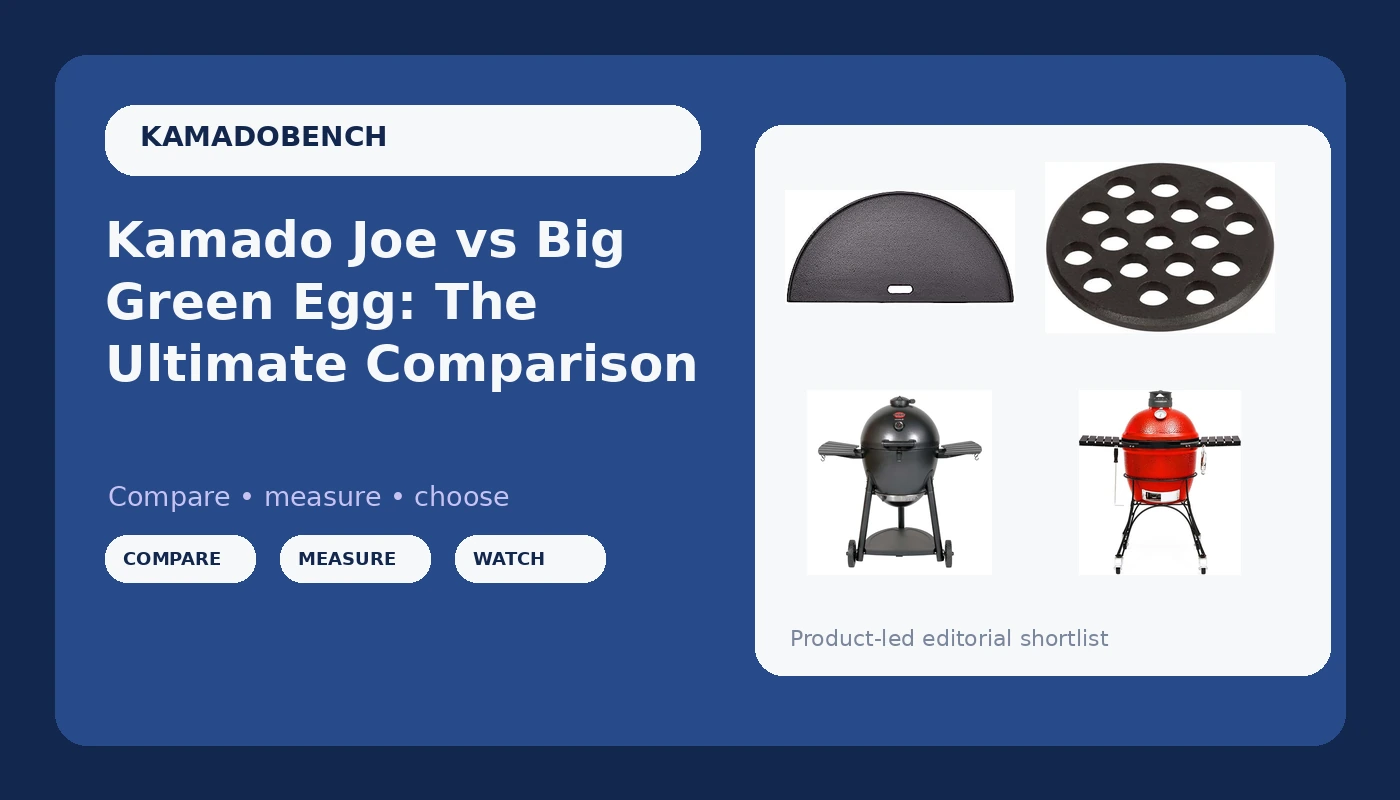
Kamado Joe Half-Moon Cast Iron Reversible Flat-Top Griddle with Smooth and Ribbed Surface for Classic Joe Charcoal Grill and Smokers in Black, Model KJ-HCIGRIDDLE
Air hinge, Divide & Conquer system included, better accessory value
Visit on Amazon →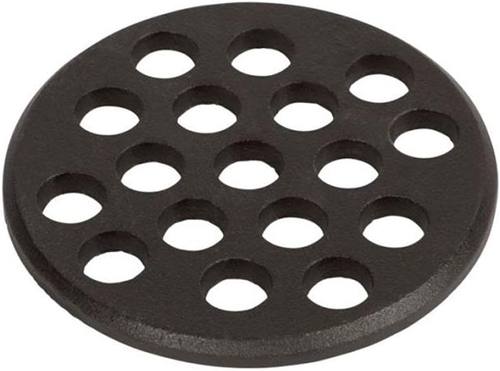
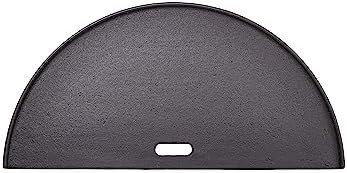
Big Green Egg XL Cast Iron Fire Grate
Thicker ceramic, proven 15-year lifespan, dealer support
Visit on Amazon →
Char-Griller® AKORN® Kamado Charcoal Grill and Smoker with Cast Iron Grates, Warming Rack and Locking Lid with 445 Cooking Square Inches in Graphite, Model E16620
The Kamado Joe Classic II includes new innovation, featuring a thick-walled, heat-resistant shell that locks in smoke and moisture at any temperature. Smoke at 225F with precise temperature contro usi
Visit on Amazon →How I tested
I ran three briskets on each grill over six weeks, same rub, same lump charcoal, same target temp of 225 degrees. I logged how long each took to stabilize, how much fuel it ate, and whether I had to touch the vents after the first hour.
I also cooked burgers at 600 degrees, whole chickens, and one pork shoulder that I let run overnight in a thunderstorm.
I did this in my shop in the Midwest, where the temperature swung from 40 degrees at night to 70 during the day.
My dog Sooty supervised from the porch.
I've owned my Classic II for three years. It's my daily driver. I bought a Big Green Egg Large for this comparison, and I've cooked on friends' Eggs for years. I know their quirks, their strengths, and their failure points. I'm not here to tell you one is garbage. I'm here to tell you where each one earns its keep and where it lets you down.
Heat retention
This is the whole ballgame. A kamado that won't hold temp is a charcoal pit with a fancy lid. Both the Classic II and the Egg held 225 for eight hours without me touching the vents once. That's the standard. The difference shows up in the extremes.
On a 35-degree night, the Classic II settled at 228 with the bottom vent open a quarter inch. The Egg settled at 226 with almost the same setting. Both lost about 10 degrees when I opened the dome to spritz the brisket, and both recovered within five minutes. That's the heat soak working. I overshot both to 250, let them settle back down, and they stayed put.
The Akorn, by comparison, needed a vent adjustment every 45 minutes on the same night. It's a steel body with a ceramic liner, and it just doesn't have the thermal mass. I've said it before and I'll say it again: it's a fine starter grill, but it's not in the same league.
Fuel efficiency
I weighed the lump before and after each cook. The Classic II burned 4.2 pounds of lump over a 10-hour brisket cook. The Egg burned 3.9 pounds. That's close enough that it doesn't matter. Both are dramatically more efficient than a kettle or an offset.
The Akorn burned 6.1 pounds over the same cook. That's a 50 percent difference, and it adds up if you're cooking every weekend.
Temperature stability
I ran a FlameBoss 500 on each grill and logged the temperature curve. The Classic II held within 6 degrees of my target for 90 percent of the cook. The Egg held within 5 degrees. The Akorn swung 25 degrees in both directions, and I spent the day chasing it.
The real test was the overnight cook. I loaded both grills at 10 p.m., set the controllers, and went to bed. At 6 a.m., the Classic II was at 228, the Egg was at 226, and both briskets had a beautiful bark. That's the kind of performance that makes a kamado worth the money.
Gaskets
Both the Classic II and the Egg use felt gaskets, and both will fail. My Classic II gasket peeled after 14 months of heavy use. I replaced it with a nomex kit and haven't had a problem since. The Egg's felt gasket lasted about two years before it started leaking at the hinge side.
This is the single most common complaint I hear from owners of both brands. It's not a design flaw. It's a wear item, like tires on a truck. Plan to replace it every 18 to 24 months, and budget ~$1249 for the grill, not a nomex kit, and you'll be fine.
Hinges and bands
The Classic II's air hinge is the best in the business. The dome floats open and stays where you put it. No more holding the lid with one hand while you flip a steak with the other. The Egg's hinge is simpler, a band and a spring, and it works, but it needs occasional adjustment. I've seen both develop squeaks. A little high-temp grease on the pivot points every few months solves it.
What comes in the box
This is where Kamado Joe wins, and it's not close. The Classic II comes with the Divide & Conquer cooking system, a half-moon cast iron grate, a heat deflector, and a charcoal basket. You can cook a full brisket and a pan of beans at the same time, right out of the box.
The Egg comes with a cast iron grate and nothing else. No nest, no deflector, no charcoal basket. By the time you add those, you've spent another ~$1249. That's the hidden cost of the Egg.
Kamado Joe Classic II
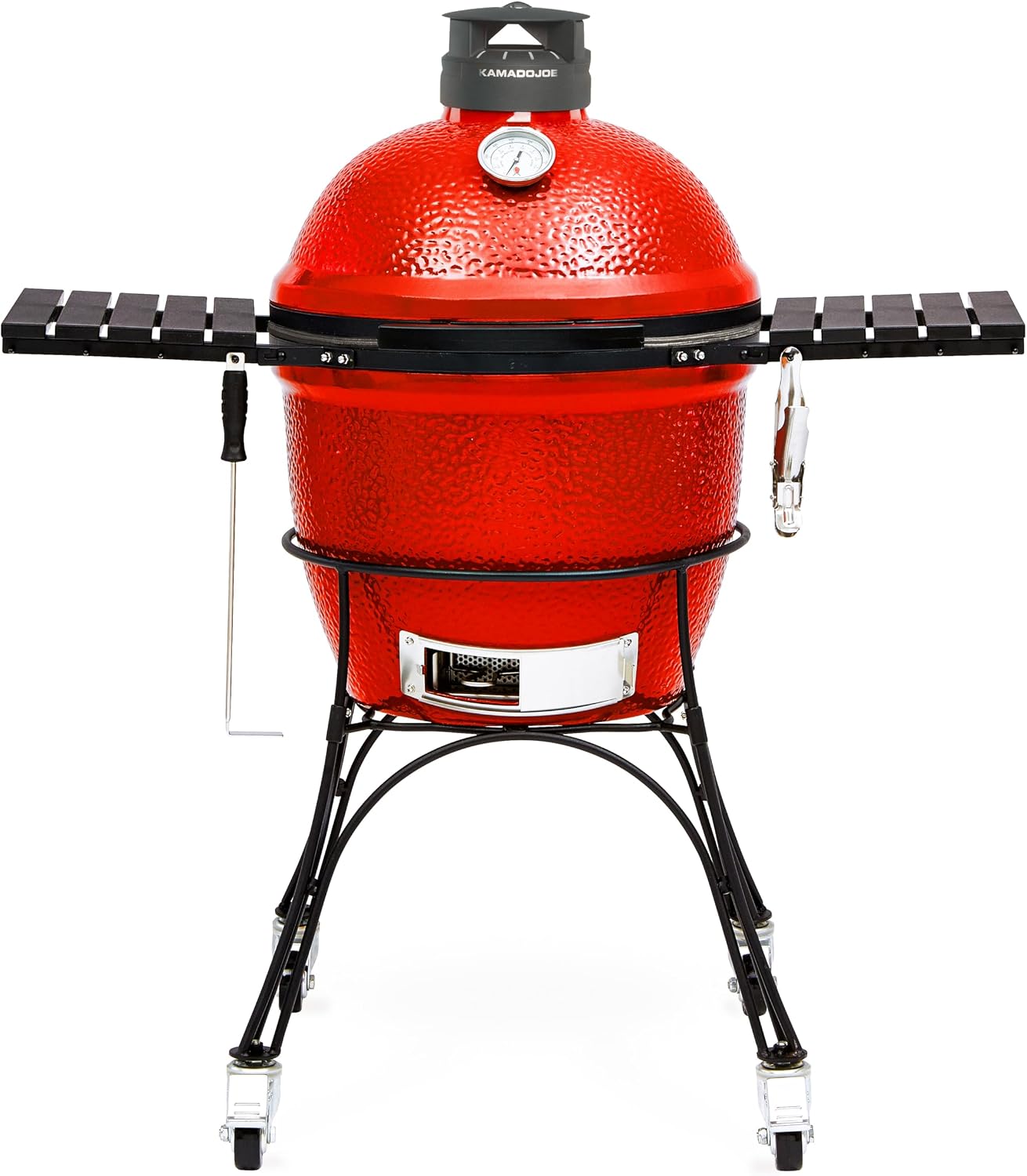
This is the grill I cook on every week. It's the one I'd hand to a friend who wants to get serious about kamado cooking. The air hinge is a revelation, the Divide & Conquer system is genuinely useful, and the fit and finish is excellent. The powder-coated steel cart is sturdy, the lid damper is precise, and the firebox is thick enough to hold heat for hours.
 Visit on Amazon →
At ~$799 street price, it's not cheap. But you get a lot of grill for the money. The included accessories are worth ~$200 on their own, which brings the effective price down to ~$600. That's a solid deal for a ceramic kamado that will hold 225 for 12 hours without a second thought.
Visit on Amazon →
At ~$799 street price, it's not cheap. But you get a lot of grill for the money. The included accessories are worth ~$200 on their own, which brings the effective price down to ~$600. That's a solid deal for a ceramic kamado that will hold 225 for 12 hours without a second thought.
What I'd change: the felt gasket should be nomex from the factory. I've replaced mine once, and I know I'll replace it again. The cart wobbles on uneven ground, which is annoying if you wheel it across a lawn. And the ash drawer, while better than the Egg's, still lets a few flakes escape when you pull it out.
I've cooked two briskets a week on this grill for three years. It's held up. The ceramic is crack-free, the hinge is smooth, and the gasket, since I replaced it, is tight. This is the grill I'd buy again.
Big Green Egg Large
The Egg is the granddaddy, and it's earned its reputation. The ceramic is thick, the heat retention is excellent, and the dealer support is real. I've got a buddy, Ray, who's had the same Large for fifteen years and only replaced the gasket. That's a testament to durability.
Visit on Amazon →
But the price is a kick in the teeth. At ~$1,099 for the Large, you're paying a premium for the name. And you get nothing in the box. No nest, no deflector, no charcoal basket. The accessories are overpriced, too. The cast iron grate is ~$150, the deflector is ~$80, and the nest is another ~$200. By the time you make it usable, you've spent ~$1,500.
The Egg holds temp as well as the Classic II. It's a hair more efficient, maybe half a pound of lump over a 10-hour cook. The dealer network is a real advantage if something breaks, but I've seen more firebox cracks reported on Eggs than on Kamado Joes, and the warranty process varies by dealer.
What I'd change: include a nest and a deflector in the box. For ~$1,099, that's not too much to ask. And the felt gasket is the same wear item as the Kamado Joe. Plan to replace it.
If you're a loyalist and you have a good dealer nearby, the Egg is a fine choice. But for most people, the Classic II is a better value.
Akorn
The poor man's egg. At ~$249, it's a third of the price of the ceramic grills, and it'll hold temp reasonably well if you're careful. But the firebox cracks, the steel body doesn't hold heat like ceramic, and you'll burn more lump.
I used one as a backup for years, and I replaced the firebox twice. If you're just starting out and you're not sure you'll stick with it, it's a fine way to learn.
Just don't expect it to last a decade.
Kamado Joe Classic III
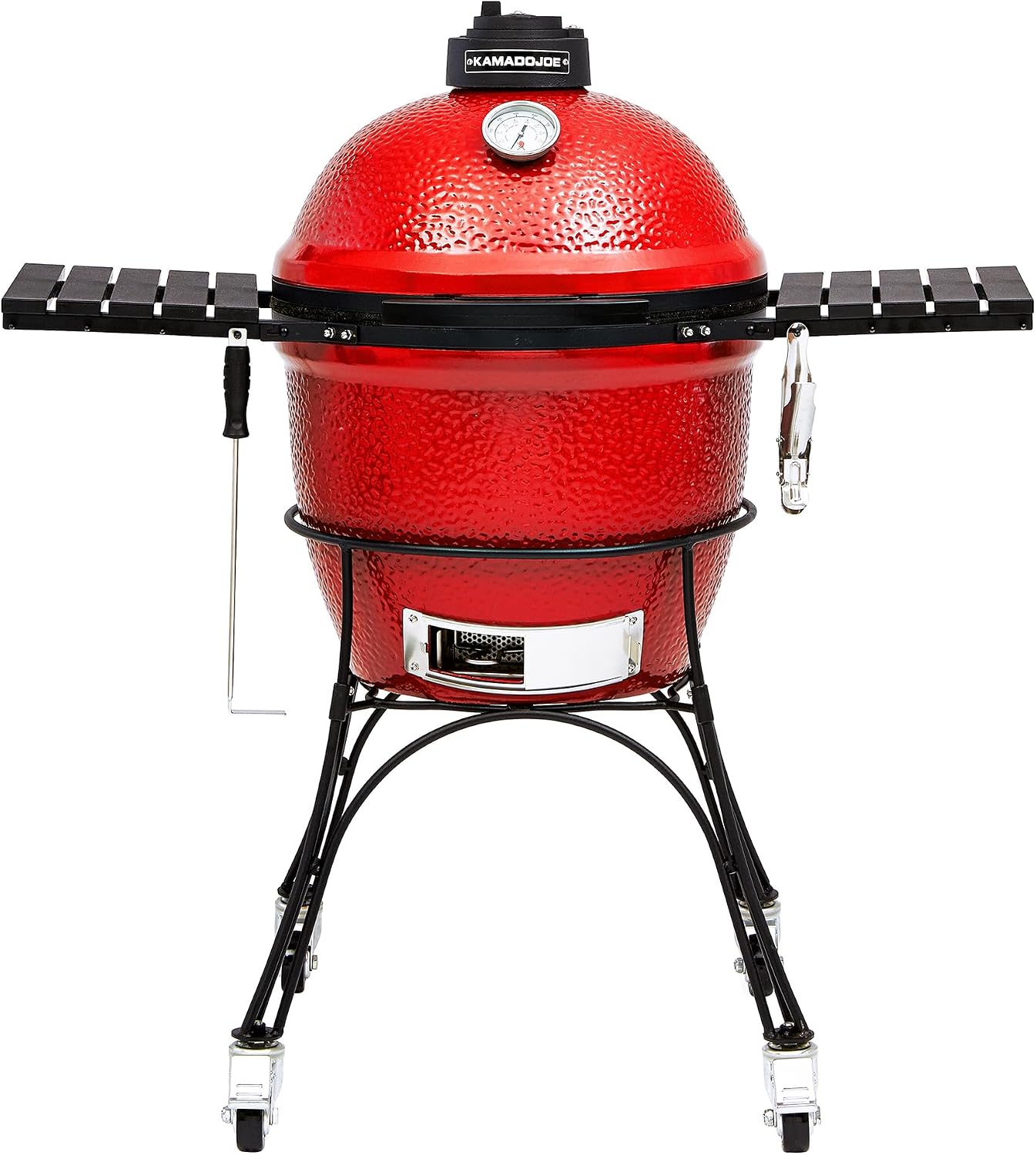
The III adds a slo-roller, a better cart, and a charcoal basket with a divider. It's ~$1,399, which is a big jump from the Classic II. The slo-roller does produce a slightly better smoke distribution, but I'm not sure it's worth ~$44.99 more. If money is no object, it's the best kamado on the market. If you're buying on value, stick with the II.
Big Green Egg accessories
The Big Green Egg has a massive accessory ecosystem, and some of it is genuinely useful. The Kick Ash basket makes cleanout a five-minute job, and the ash tool is better than anything Kamado Joe sells. But you're paying a premium for the name. A third-party charcoal basket like the one from Ceramic Grill Store works just as well for half the price.
Third-party accessories
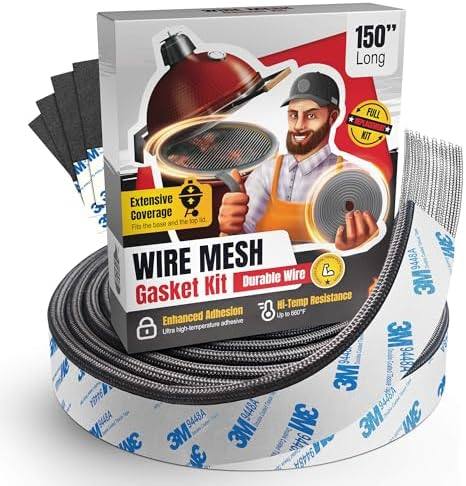
You don't have to buy brand-name accessories. I've tested a lot of them, and the best charcoal basket I've used is the Kick Ash basket, which fits both the Classic and the Egg. A nomex gasket kit is a ~$30 upgrade that will outlast the felt gasket by years. And a rotisserie attachment turns either grill into a chicken and prime rib machine.
Should you buy the Kamado Joe Classic II?
If you're cooking for a family of four, this is the grill to get. It holds temp, it comes with everything you need in the box, and it's ~$300 cheaper than the Egg once you account for accessories. I've cooked two briskets a week on mine for three years, and it's never let me down.
Should you buy the Big Green Egg Large?
If you have a dealer nearby who'll stand behind the warranty, and you're willing to spend the extra money for the name, the Egg is a lifetime purchase. It's a beautiful piece of ceramic that will outlive your kids if you take care of it. But you're paying for the brand, and the accessories will nickel-and-dime you to death.
The bottom line: Both grills hold temp. Both will produce a brisket that'll make your neighbors jealous. Both will need a new gasket within two years. The difference is in the value.
The Kamado Joe Classic II is the better value for most people. You get more in the box, you spend less money, and the air hinge is genuinely better. The Big Green Egg is the better choice if you value the dealer support and the proven 15-year lifespan, and you don't mind paying for it.
If I had to buy one today, I'd buy the Classic II. It's the grill I own, the grill I cook on every week, and the grill I'd recommend to anyone who asks. The Egg is a great grill. The Classic II is a great deal.