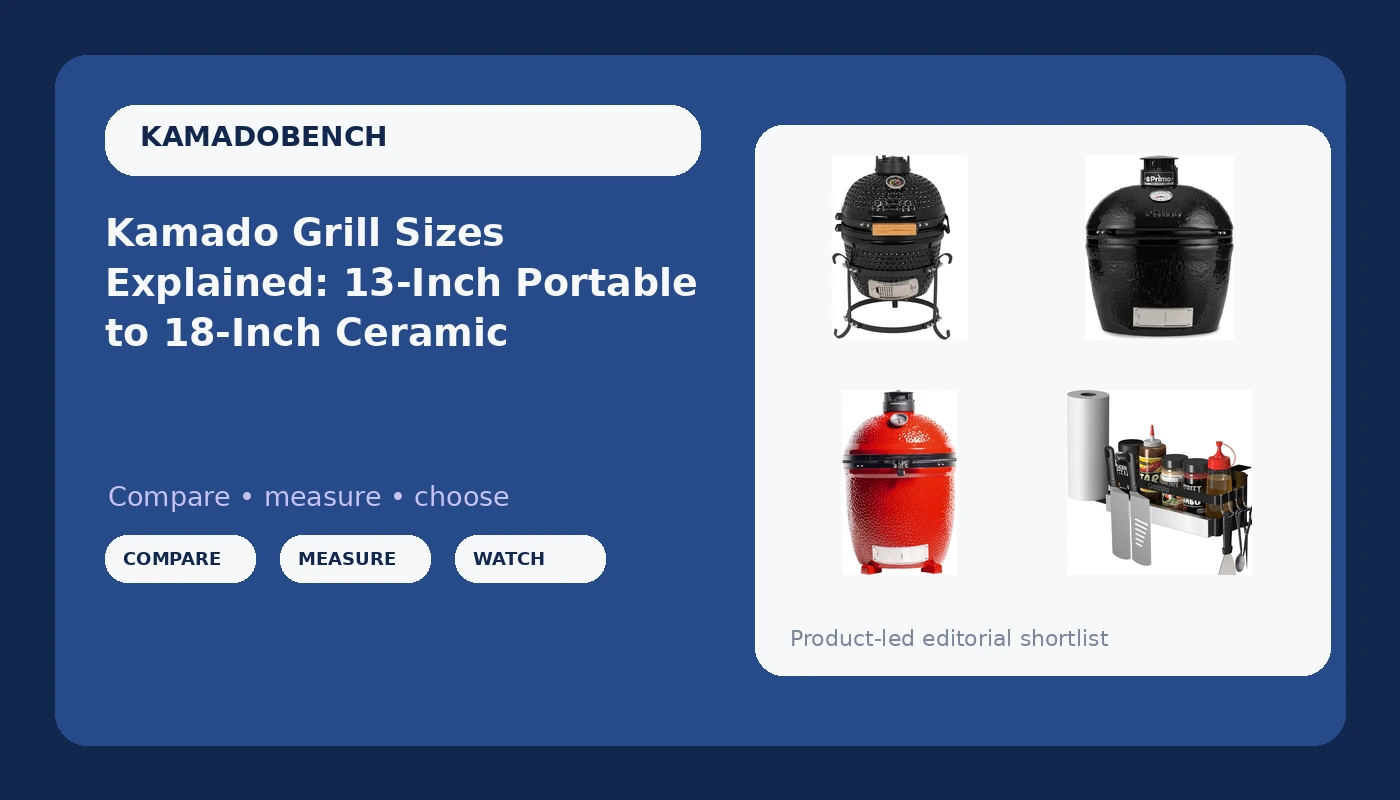
Kamado grill sizes are the spec that quietly decides everything else. A 13-inch portable and an 18-inch ceramic both burn lump charcoal, both cook with the lid down, and both hold heat better than a thin steel kettle. What separates them is volume: how much fuel fits in the firebox, how much food fits over the fire, and how much ceramic mass has to heat soak before the cooker will sit at 250 degrees without drifting. Buy too small and a packer brisket will not fit; buy too big and you will burn a full load of charcoal to cook two chicken breasts on a Tuesday. This explained guide walks the size classes, covers four pieces of gear that span the range from a camping kamado to a large oval, and gives you a decision order to run through before you spend a dollar.
Related: Kamado Temperature Control: Vents, Heat Soak, and Overnight Cooks →
Quick answer
Match the kamado to the biggest cook you will genuinely do more than twice a year, not the biggest cook you imagine. A 13-inch kamado is a portable cooker for steaks, chicken pieces, and small joints. An 18-inch ceramic is the size most backyard cooks settle on for ribs, pork shoulder, and a brisket that fits. A large oval kamado adds a longer footprint for bigger loads and more flexible fire placement. Ceramic thickness and firebox warranty coverage matter more than the badge on the lid, and no kamado is a set-and-forget appliance, so plan on learning vent control and a 30 to 45 minute heat soak before any low-and-slow cook.
Four useful options
| Model | Best fit | What stands out |
|---|---|---|
| Kamado Joe® Classic Joe™ III Standalone 18-inch Charcoal Grill in Red, Grill Gripper, and Ash Tool | A primary backyard kamado for a household that cooks year round | 18-inch ceramic body, standalone configuration, ships with a grill gripper and an ash tool |
| Primo Oval Large 300 Ceramic Kamado Grill with Stainless Steel Grates - PGCLGH (2021) | Cooks who want a long oval footprint for bigger cuts and larger loads | Oval ceramic body with stainless steel cooking grates |
| VINGLI 13" Kamado Charcoal Grill Portable Barbecue Grill BBQ Kettle Stand Lid Perfect for Outdoor Camping Patio Backyard Picnic | Camping, picnics, patios, and small weeknight cooks | 13-inch kamado body on a kettle-style stand with a lid |
| Geesta Upgraded Griddle Caddy for 28"/36" Griddles/Weber Grill/Prep Cart, BBQ Grill Accessories Space Saver with Magnetic Tool Holder & Paper Towel Holder | Organizing tools and paper towels at the cook station | Magnetic tool holder plus a paper towel holder, sized for 28-inch and 36-inch griddles, Weber grills, and prep carts |
The 18-inch ceramic anchor: Kamado Joe® Classic Joe™ III Standalone 18-inch Charcoal Grill in Red, Grill Gripper, and Ash Tool
Eighteen inches is the class where a kamado stops being a novelty and starts being a cooker. It is wide enough for a full rack of ribs laid flat or a modest packer brisket, and it carries enough ceramic mass that a stabilized fire does not swing every time you open the lid. The trade is weight and warm-up time: more ceramic means a longer heat soak before the dome settles, and it means the cooker stays where you put it. The word standalone in the listing is worth reading carefully. It tells you the grill is the purchase, and the cart, table, or patio pad it sits on is a separate decision you should make before delivery day. The included grill gripper and ash tool cover two chores every kamado owner does constantly, moving hot grates and clearing the firebox, so you are not improvising with tongs on the first cook.
The large oval: Primo Oval Large 300 Ceramic Kamado Grill with Stainless Steel Grates - PGCLGH (2021)
Shape matters as much as diameter once you get into the large classes. An oval footprint generally gives you a longer cooking surface than a round kamado of similar width, which changes how you lay out ribs, a brisket, or a couple of pork butts. It also changes airflow: a longer firebox is less uniform end to end, so you may find one side of the grate runs hotter and you will learn to rotate food or build a smaller fire offset to one side. Stainless steel grates are a practical detail. They tolerate a wire brush, they do not need the seasoning care cast iron does, and they will outlast several sets of the thin chrome grates that come on cheap cookers. The trade for all that volume is fuel. A bigger firebox eats more lump per cook, and the ceramic takes longer to come up to temperature, so this is a cooker for planned sessions rather than a quick weeknight sear.
The compact portable: VINGLI 13" Kamado Charcoal Grill Portable Barbecue Grill BBQ Kettle Stand Lid Perfect for Outdoor Camping Patio Backyard Picnic
A 13-inch kamado is a different animal, and that is the point. Less ceramic mass means it comes up to temperature quickly, and it also means the temperature moves quickly when you open the lid or the wind picks up. That makes it a good searing and grilling cooker for steaks, chops, chicken pieces, sausages, and small roasts, and a poor candidate for an overnight brisket. If you want low and slow on a cooker this size, expect a shorter cook and more attention, not a 12-hour unattended burn. Where this class earns its keep is travel. A 13-inch body on a stand is something one person can move, which opens up tailgates, campsites, and small patios where a full-size ceramic would never fit. Treat it as a second cooker or a starter cooker, not as a replacement for an 18-inch kamado, and you will be happy with it.
The cook-station add-on: Geesta Upgraded Griddle Caddy for 28"/36" Griddles/Weber Grill/Prep Cart, BBQ Grill Accessories Space Saver with Magnetic Tool Holder & Paper Towel Holder
This one is not a kamado, and it belongs in the conversation anyway, because a kamado cook is a two-hand operation. One hand holds the lid or works the vents, and the other hand is reaching for a probe, a glove, or a towel, usually while something is at 225 degrees and climbing. The caddy answers the question of where all of that lives. Its mounting is magnetic, which means it needs a ferrous metal surface to hold on to. A ceramic kamado shell will not hold it, so the natural home is a steel prep cart, a steel side shelf, or the side of a griddle. If your setup is a kamado on a patio pad with nothing else around it, this is an item you buy after you add a cart, not before.
Prices and availability may change. Product images, names, and retailer links are matched to verified listings. No current price, rating, stock status, or measured result is stated here without current evidence.
What kamado size actually changes
Size affects five things, and they all compound.
Grate area sets the largest single piece of food you can cook and how many pieces you can cook at once. This is the number most buyers focus on, and it is the easiest one to overestimate.
Firebox volume sets how much lump charcoal you can load, which in turn sets how long a full load burns at low temperature. Bigger firebox, longer burn, more fuel per cook.
Thermal mass sets heat soak time. Thick ceramic takes longer to stabilize, but it also resists temperature swings when the lid opens or the weather turns. Thin ceramic warms fast and reacts fast, which is a benefit for grilling and a liability for long cooks.
Airflow sensitivity sets how much a small vent change moves the needle. Small cookers react to tiny adjustments. Large cookers are more forgiving but slower to correct.
Portability sets whether the cooker travels or stays. Ceramic gets heavy fast, and a kamado that is a permanent installation is a different purchase from one that goes in a truck bed.
Matching a kamado to the way you cook
- Write down the three cooks you make most often, then the one big cook you do a few times a year. Size for that list, not for a fantasy brisket you will smoke once.
- Measure the footprint and the lid clearance. A kamado needs room for the dome to swing open, and it needs to sit far enough from a wall or railing that you are not fighting the lid every cook.
- Decide whether the cooker stays put or travels. A standalone 18-inch ceramic is a permanent installation; a 13-inch portable on a stand is not.
- Budget the whole setup, not the cooker alone. Fuel, a cover, a digital thermometer, heat-resistant gloves, and a place to set hot grates are all part of the real cost.
- Read the warranty language for the firebox and the gasket before you buy, and know what you will need to prove if the firebox cracks. The firebox is the part most likely to fail, and the warranty is what decides whether that failure is an inconvenience or a loss.
Practical guidance
- Learn vent control before you buy a temperature controller. A controller is useful for overnight cooks, but it cannot fix a fire that was built wrong.
- Buy a digital thermometer with at least two probes. Dome thermometers read the air at the top of the cooker, not the meat, and they are routinely off.
- Expect the gasket to be the first wear item. When the seal goes, temperature control goes with it, so check it every few cooks.
- Keep one brand of lump charcoal and use it consistently. Changing fuel mid-season changes how your vents behave, and you will spend a month relearning your cooker.
- Plan the cook station, not just the cooker. Tools, gloves, a towel, and a probe need a home within arm's reach, or you will be walking to the kitchen with the lid open.
Which option should you choose?
Choose the Kamado Joe® Classic Joe™ III Standalone 18-inch Charcoal Grill in Red, Grill Gripper, and Ash Tool when you want one ceramic kamado as your primary backyard cooker and you are ready to learn vent control and heat soak. Choose the Primo Oval Large 300 Ceramic Kamado Grill with Stainless Steel Grates - PGCLGH (2021) when you want the longer footprint and stainless grates that come with a large oval body and you plan bigger, longer cooks. Choose the VINGLI 13" Kamado Charcoal Grill Portable Barbecue Grill BBQ Kettle Stand Lid Perfect for Outdoor Camping Patio Backyard Picnic when portability and fast warm-up matter more than low-and-slow capacity. Choose the Geesta Upgraded Griddle Caddy for 28"/36" Griddles/Weber Grill/Prep Cart, BBQ Grill Accessories Space Saver with Magnetic Tool Holder & Paper Towel Holder when you already have a steel cart, side shelf, or griddle and need the tools and towels off the ground.
Listings change, and included items can change with them. Confirm the dimensions, the configuration, and what ships in the box on the product page before you order, and do not treat any description here as a substitute for those details.
The bottom line
Size is the one kamado decision you cannot fix later with an accessory. An 18-inch ceramic covers the widest range of real backyard cooking, a large oval buys you more footprint at the cost of more fuel and a longer warm-up, and a 13-inch portable is a second cooker that travels well and grills fast. Decide which of those you are actually buying, then check the firebox warranty, learn your vents, and give the ceramic the heat soak it needs before the meat goes on.