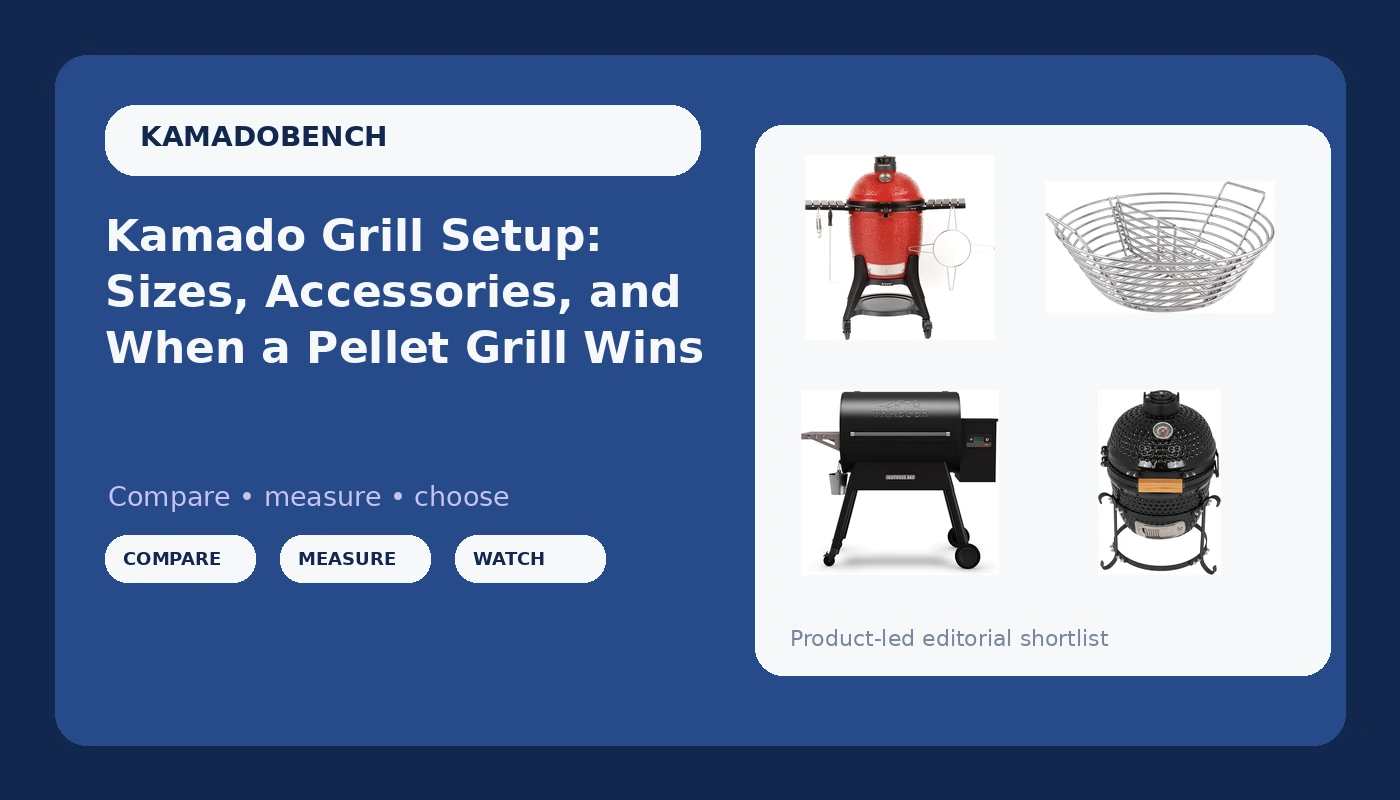
A kamado grill setup is rarely one purchase. It is a size decision, a fuel decision, and an airflow decision, and getting any of those three wrong is how a good brisket turns into charcoal. The ceramic does the actual work of holding temperature. The cart, the side shelves, the gripper, and the ash tool are convenience, and convenience is worth paying for only after the cooker is the right size for the cooking you do.
Most shoppers compare brand names and dome colors while the real differences sit in cooking diameter, ceramic mass, fuel type, and what the warranty says about the firebox. The four pieces of equipment below show up in the same conversation for a reason: an 18-inch ceramic kamado, a 13-inch portable ceramic, a divided fire basket, and a WiFi pellet grill that is not a kamado at all. Each one solves a different problem, and none of them solves every problem.
Related: Kamado Temperature Control: Vents, Heat Soak, and Holding 250 →
Quick answer
Match the cooker to the cook. An 18-inch ceramic kamado is sized for full packer briskets, pork butts, and multi-zone cooking, which is where the three-tier system on the Kamado Joe Classic Joe Series III earns its place. A 13-inch round ceramic kamado is a small-format cooker for steaks, chicken, and short sessions. A stainless fire basket with a divider changes how you arrange lit and unlit charcoal inside a large kamado. The Traeger Ironwood 885 is a wood pellet grill with WiFi, so it holds temperature with an auger and a controller instead of ceramic mass and manual vents.
Four useful options
| Model | Best fit | What stands out |
|---|---|---|
| Kamado Joe® Classic Joe™ Series III 18-inch Charcoal Grill & Smoker | Full-size low-and-slow and multi-zone cooking | 18-inch ceramic body with cart, side shelves, three-tier cooking system, stainless steel cooking grates, grill gripper, and ash tool |
| Lump Charcoal Fire Basket with Divider | Rearranging fuel in a large ceramic kamado | Stainless steel basket with a divider for separating lit and unlit charcoal; sized for the Large Big Green Egg and Kamado Joe Classic |
| 13" Round Ceramic Kamado Charcoal Grill | Small batches, small spaces, short cooks | 13-inch round ceramic body in a portable egg design; includes an ash tool |
| Traeger Ironwood 885 Wood Pellet Grill & Smoker | Hands-off temperature control and WiFi monitoring | Wood pellet fuel with 885 square inches of cooking area and WiFi connectivity |
The centerpiece: Kamado Joe® Classic Joe™ Series III 18-inch Charcoal Grill & Smoker
The trade-off here is footprint. A ceramic kamado in this class is a permanent piece of patio furniture. It is heavy, it wants a stable surface, and it does not travel. What you get for that commitment is cooking area and stored heat, plus a package that includes the cart, the shelves, the gripper, and the ash tool rather than selling them separately. If your cooking is mostly weeknight chicken and steaks for two, this is more cooker than the job requires.
The fuel upgrade: Lump Charcoal Fire Basket with Divider
This is the kind of accessory that quietly changes a cook more than a new thermometer does. Separate lit and unlit fuel in one basket and you can stretch a burn or run two zones without rebuilding the fire. It will not make a thin-walled cooker hold temperature, and it adds one more part to scrape clean. Sizing comes from the listing, so confirm it matches your specific kamado before ordering.
The small format: 13" Round Ceramic Kamado Charcoal Grill
The honest limitation of a 13-inch kamado is grate area. Think two steaks, a spatchcocked chicken, or a small roast, not a packer brisket. Less ceramic mass also means the cooker reacts faster to vent changes in both directions, which is forgiving on a short cook and less forgiving on a long overnight burn. For a small household, a balcony, or a second cooker running sides while the big one works, that trade is often the right one.
The different animal: Traeger Ironwood 885 Wood Pellet Grill & Smoker
The dependency list is the trade-off. A pellet grill needs electricity and a dry supply of pellets, and the controller, auger, and fan are parts that can fail in ways a ceramic dome and two vents cannot. In exchange you get set-and-monitor temperature control and WiFi, which is a real advantage for a beginner or for anyone who wants to cook overnight without tending a fire. It is not a kamado, and it should not be judged as one.
Prices and availability may change. Product images, names, and retailer links are matched to verified listings. No current price, rating, stock status, or measured result is stated here without current evidence.
Why ceramic mass and the gasket decide your temperature
A kamado holds temperature because two things work together: the mass of the ceramic and the seal around the lid. The walls and dome absorb heat during the warm-up and radiate it back into the cooking chamber. That stored heat is what lets a kamado run for hours on one load of lump charcoal, and it is also why the cooker takes thirty to forty-five minutes to stabilize. Skipping the heat soak and putting meat on a dome that is still climbing is one of the most common ways a long cook goes wrong.
Thickness matters more than the name on the dome. Two ceramic cookers at the same price can be very different pieces of ceramic, and thin walls show up as temperature swings, faster fuel consumption, and a firebox that cracks sooner. This is why the cheap "kamado style" grills at the hardware store are a false economy: thin ceramic, gaskets that peel within a season, and a firebox that lets go on the first hard cold snap.
The gasket is the other half of the equation. It is a wear item, not a permanent part. When it flattens or peels, air leaks past the lid and every vent setting you dial in becomes approximate. If the dome will not hold a steady 250, check the seal before you blame the charcoal.
Vent control sits on top of all of it. The bottom vent sets how much air reaches the fire; the top vent trims the exhaust. Make small adjustments, then wait. A kamado responds slowly, and chasing the temperature with big vent moves turns a stable cook into a rodeo.
Lump charcoal, a divided basket, and pellets: three fuel systems
Lump charcoal is the default fuel in a ceramic kamado. It lights quickly, burns hot when you want it to, and leaves less ash than briquettes, which matters because ash is what chokes airflow at the bottom of the firebox. Ash management is not glamorous, but a kamado that will not climb past 300 is usually a kamado with a clogged grate.
How you arrange that charcoal changes the cook. In a large kamado, a stainless basket with a divider lets you keep lit fuel on one side and unlit fuel on the other in the same load. The lit side carries the early heat, the unlit side catches gradually, and the result is a longer, flatter burn plus an easier time running two temperature zones. A raised basket also lets ash fall clear of the fire instead of smothering it.
Pellets are a different system entirely. A pellet grill stores fuel in a hopper, an auger feeds it into a fire pot, and a controller decides how much fuel and air the fire gets. WiFi connectivity lets you watch the temperature from inside the house. What you gain is consistency and hands-off operation. What you give up is the radiant ceramic mass, the ability to run on charcoal and airflow alone, and any cooking at all when the power is out. Pellets also have to stay dry, because damp pellets feed unevenly.
Here is the order I would work through the choice:
- Measure the cooking you actually do most weeks, not the cook you imagine hosting once a year.
- Pick the fuel system first: lump charcoal in ceramic, or pellets with a controller.
- Size the grate to the largest thing you genuinely cook, then check that the footprint fits your patio.
- Read the warranty language for the firebox and the gasket before you read the marketing copy.
- Budget for one accessory that solves a real problem, such as a divided fire basket, instead of a drawer full of gadgets.
Practical guidance before you buy
- Learn the vents before you buy a temperature controller. A controller is genuinely useful for overnight cooks, but it manages a fire you still have to load and light correctly.
- Plan the heat soak into the timeline. Thirty to forty-five minutes of stabilization is part of the recipe, not wasted time.
- Clear ash regularly. Airflow is the whole control system, and ash is what blocks it.
- Treat the gasket as a consumable. Inspect the seal, and expect to replace it eventually on any kamado.
- Verify fit and clearance for accessories. A fire basket sized for a Large Big Green Egg and Kamado Joe Classic will not fit every ceramic cooker, and a 13-inch kamado has its own footprint on a cart or table.
Which option should you choose?
Choose the Kamado Joe® Classic Joe™ Series III 18-inch Charcoal Grill & Smoker when you want one full-size ceramic cooker for briskets, butts, and multi-zone sessions, and you would rather buy the cart, shelves, and tools as one package. Choose the Lump Charcoal Fire Basket with Divider when you already own a large ceramic kamado and want more control over how the fuel load burns. Choose the 13" Round Ceramic Kamado Charcoal Grill when your cooking is small-batch and your space is tight, and you want ceramic heat retention in a portable format. Choose the Traeger Ironwood 885 Wood Pellet Grill & Smoker when hands-off temperature control and WiFi monitoring matter more to you than charcoal and ceramic.
None of these listings tells you how a cooker behaves on your patio, in your weather, or with the charcoal you buy. Check dimensions against your space, read the firebox and gasket warranty terms, and confirm what is included in the box on the current listing before you commit.
The bottom line
A kamado grill setup works when the ceramic, the fuel, and the airflow plan match the cooking you actually do. Size comes first: an 18-inch ceramic covers most backyard low-and-slow work, while a 13-inch kamado is a small-format cooker with a smaller appetite. The cheapest meaningful upgrade to a large kamado is often a divided fire basket, because it changes the burn rather than the decor. A pellet grill such as the Ironwood 885 is a different tool with different dependencies, electricity and dry pellets among them, and it is worth choosing on purpose rather than by accident. Whatever you pick, learn the vents, respect the heat soak, and read the firebox warranty before the first cook.