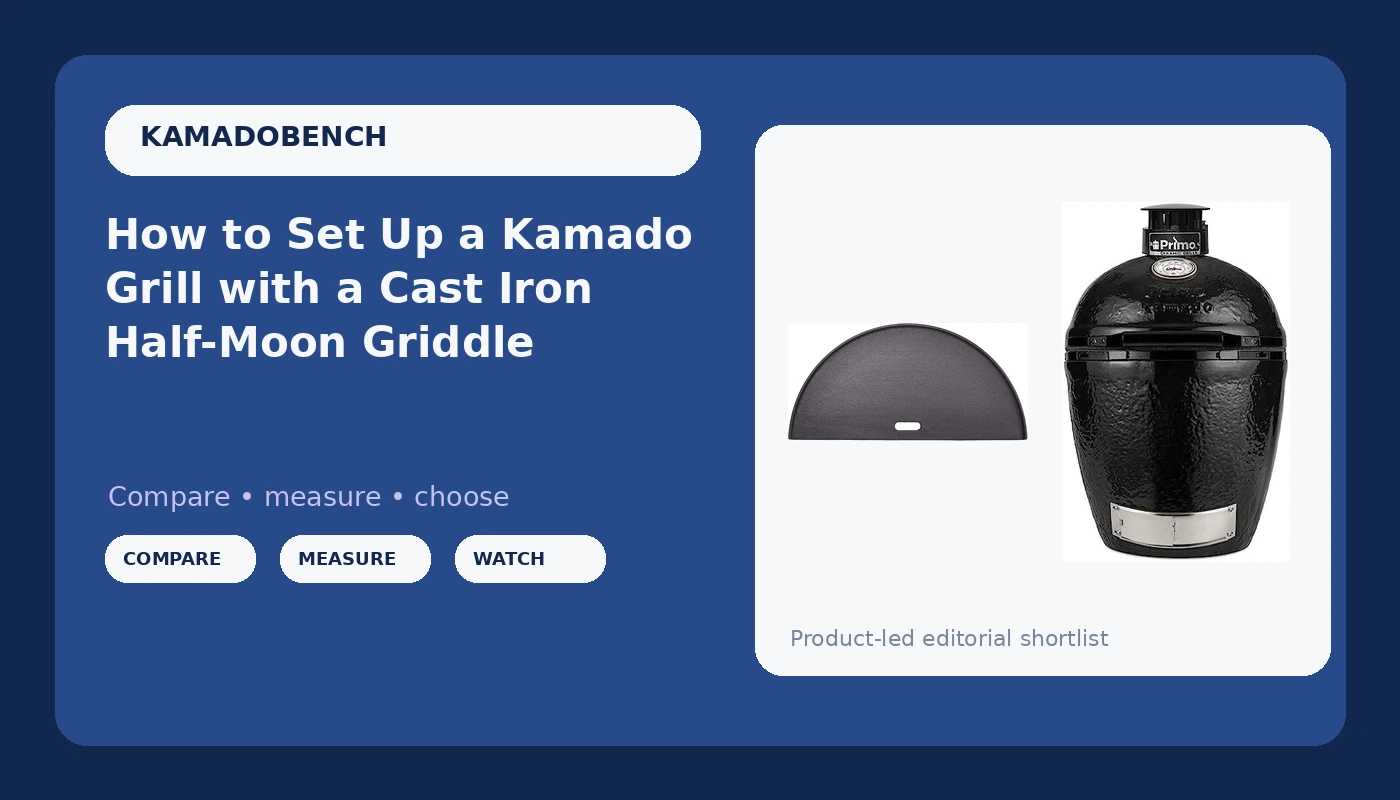
A kamado cast iron griddle is the cheapest way to double the cooking surface you already own. Not the flashiest upgrade. The cheapest, and the one I would make before I bought another thermometer.
Here is the thing about a ceramic kamado. It is a single-zone oven with a lid on it. You can hold 225 for a brisket or push 650 for a steak, but you cannot sear on one side and hold a drip pan on the other unless you give the fire something to work with. A half-moon griddle dropped onto half the grate solves that. One half becomes a flat top for smash burgers, onions, peppers, and Sunday breakfast. The other half stays open for direct heat or a pan.
I have been cooking on kamados for 18 years, from a $400 egg to a $4,000 one, and the accessory drawer is where the real value hides. This guide is about setting up a griddle on a round ceramic grill without choking the airflow, cracking anything, or losing a Saturday to your own equipment.
If you already own a kamado, the whole job is one accessory and about an hour of attention. If you are still shopping, read the grill section first, because the accessory only works if the grill underneath it holds temperature.
Why you should trust me
I cook competition barbecue out of Savannah, Georgia, and I have been doing it for 18 years. Two briskets a week go on my cookers, every week, year round. That means I have watched more gaskets fail and more fireboxes crack than most people see in a lifetime of backyard cooking. I have spent years and more kamados than I want to admit figuring out which ones hold temperature through a Georgia thunderstorm and which ones turn a $90 brisket into charcoal.
The rule I cook by is simple. A kamado's whole job is holding temperature, and everything else is marketing. Thick ceramic, a gasket that actually seals, and vents you can adjust in small increments. That is the whole machine. Accessories either support that or get in the way of it, and a cast iron griddle is one of the few that clearly supports it.
I do not do set-and-forget claims. A kamado needs attention, period. Anyone who tells you otherwise is selling you a controller.
How I judge kamado gear
What I look for before anything gets recommended:
- Ceramic mass. Two eggs at the same price can be very different pieces of ceramic, and the thin one will run hot and cold on you all afternoon.
- The gasket. When the seal fails, your temperature control fails with it. A gasket that peels in a season is a design flaw, not normal wear.
- The firebox and the warranty behind it. The firebox will crack eventually. The question is whether the warranty replaces it without a fight.
- Heat soak behavior. A kamado needs 30 to 45 minutes to stabilize. Skipping the soak is how briskets get ruined, and it is also how cast iron accessories get blamed for problems they did not cause.
- Whether the accessory blocks airflow. A griddle that covers too much of the firebox gap turns your kamado into a smoker with one hand tied behind its back.
That is the lens I use on everything below. I am not going to hand you a temperature log for a grill I have not cooked on, and I am not going to pretend a product name is a measurement. What I can tell you is what the design does, what the name and shape tell you, and where the fit gets tricky. It is almost always at the grate.
The grill you are cooking on
Everything else in this guide hangs off the grill, so start here. If the ceramic cannot hold a dome temperature through a long afternoon, no accessory on the market saves the cook.
The grill: Primo Large Round Ceramic Kamado Grill - PGCRH (2021)
 Visit on Amazon →
Check current Amazon price before you plan a budget around it, because kamado pricing moves with the season.
Round is the part that matters for this setup. A full circle of grate means two half-moon accessories make a complete circle, and one half-moon leaves you a clean half to work with. On an oval or a rectangular kamado you get more surface area but a clumsier accessory layout, and the flat top ends up sitting in an odd place relative to the fire.
What you are buying at this size is ceramic mass. A large round body holds heat, which is exactly what you want when you drop a slab of cast iron onto the grate. The iron pulls heat out of the dome the moment it goes on cold, and a heavy ceramic body recovers faster than a thin one. That recovery is the difference between a griddle that sears and a griddle that steams.
Flaws but not dealbreakers: A large ceramic grill is heavy and it is a commitment. Once it is set, you are not moving it alone, and it needs a stable, level surface. Also, "large" means something different to every brand, so measure your grate diameter before you order any half-moon accessory.
Anyone who wants one cooker that can do a 12-hour brisket and a Tuesday night of burgers will get their money's worth here.
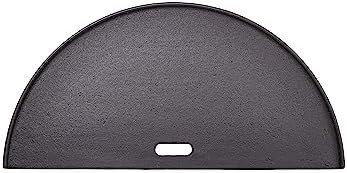
The griddle: Kamado Joe Half-Moon Cast Iron Reversible Flat-Top Griddle with Smooth and Ribbed Surface for Classic Joe Charcoal Grill and Smokers in Black, Model KJ-HCIGRIDDLE
 Visit on Amazon →
Check current Amazon price. This is the inexpensive half of this article, and it is the half that changes what you can cook.
Cast iron is the right material for a kamado griddle, and reversible gives you two tools in one slab. The smooth face is for smash burgers, eggs, fish, onions, and anything you want full contact on. The ribbed face gives you grill marks and lets fat run off into the fire, which matters when you are cooking bacon or a fatty burger and do not want a puddle of grease under the food.
Cast iron holds heat, and inside a kamado that is a feature rather than a chore. The ceramic is already doing the heat-holding work, so the griddle stays hot through a flip and a press instead of dropping the moment cold food lands on it.
The name says it is built for the Classic Joe, and that is worth reading carefully. Half-moon accessories are sized to a specific grate. A half-moon that is slightly too big will sit proud, rattle, or fail to seat at all, and one that sits high enough can cut into your dome clearance for tall cooks like a beer can chicken. Before you order, measure across your grate and check the clearance between the grate and the fire ring. On a different round kamado, a half-moon of the right diameter usually drops in fine, but usually is not the same as guaranteed.
Flaws but not dealbreakers: It is heavy, it needs a real seasoning before it behaves, and it will rust if you leave it wet. It also eats half your grate, which is the point, but plan the cook around it.
Anyone who wants flat-top cooking on a grill they already own should start here.
The actual setup and cook workflow
Now the part you came for. This works on any kamado with a two-piece grate or a grate you can remove a section from.
Step one: Light it and leave it alone. Load your charcoal, light it in one spot, and let the dome come up to temperature slowly. Thirty to 45 minutes of heat soak is not optional. Cast iron dropped into a kamado that has not stabilized will drag your dome temperature down and you will spend the next hour chasing it with the vents.
Step two: Set your target before the griddle goes on. For flat-top cooking you want a dome somewhere between 400 and 500. For a mixed cook where the open half is doing chicken and the griddle is doing vegetables, 375 is a friendlier number. Get the dome settled first. Then add iron.
Step three: Pick the face. Smooth side up for eggs, smash burgers, fish, and anything delicate. Ribbed side up for steaks, bacon, and anything you want marked and drained. You flip the slab, not the food, so decide before it gets hot.
Step four: Seat it properly. Drop the half-moon onto one side of the grate so it sits flat and does not rock. Leave the other half open. If the griddle covers the gap between the firebox and the fire ring on both sides, you have cut off your airflow, and the fire will starve no matter what the top vent says.
Step five: Season it, then cook on it. Warm the iron, wipe a thin film of a high smoke point oil across the surface, and let it sit until it stops smoking. Repeat once. You are not deep frying it, you are sealing it. A properly seasoned griddle releases a burger without a spatula fight.
Step six: Give the iron time to come back. Cast iron drops when cold food hits it. Let the griddle recover for a minute or two between batches instead of crowding it. This is the single most common mistake with flat-top cooking on a kamado.
Step seven: Run two zones. The griddle side runs hot and flat for searing and finishing. The open side runs direct over the coals or indirect with a heat deflector underneath, depending on what you are cooking. You now have a griddle and a grill in the same ceramic shell, which is the entire reason to own one of these.
Step eight: Clean it warm, not later. While the griddle is still warm, scrape it with a metal spatula, wipe it with a rag, and lay down a thin coat of oil. Never soak cast iron and never run it through a sink of soapy water. Close both vents when you are done, let the coals die on their own, and never dump water into the firebox to speed it up. That is how you crack ceramic.
The competition, and why it loses
The alternatives to a cast iron half-moon are all reasonable tools, and all of them give something up on a kamado.
A bare grate is free, and it is what you already have. It gives you direct heat and grill marks, but nothing flat. Eggs, smash burgers, diced vegetables, and fish fillets all fall through or stick. That is the gap a griddle fills.
A nonstick griddle pan is light and easy to clean, and it is the wrong tool for a kamado. Nonstick coatings are not built for the temperatures a ceramic grill can reach, and one accidental high-heat session can ruin the surface. Cast iron does not care.
A thin steel plancha heats fast, which sounds good until it warps over a hot fire and stops sitting flat. Flat is the entire job.
Soapstone is the other half-moon worth considering, and it is excellent for fish and delicate proteins. It is a different tool, though. It does not give you the ribbed face, it does not hold the same kind of heat through a press, and it chips if you handle it carelessly. If you want one accessory that does both flat-top cooking and marks, cast iron wins.
What this all costs
Here is the honest math. The griddle is the small line item. The grill is the lifetime purchase. Both prices move, so check current Amazon price on each before you decide, and do not build a budget on a number you saw three months ago.
The way to think about it is cost per cook. If you cook on your kamado twice a week, the accessory is the cheapest thing in your setup by a wide margin, and it is the thing that unlocks weeknight meals. A kamado that only gets fired up for long weekend cooks is an expensive piece of furniture. A kamado that gets used on a Tuesday because the griddle is sitting on half the grate earns its space.
The other cost is attention. A kamado needs a heat soak, it needs vent adjustments in small moves, and it needs the lid shut while you cook. Nothing about a cast iron griddle changes that. It just gives the fire a second job.
The short version
Stabilize the dome before the iron goes on. Seat the half-moon on one side so the other half stays open and the fire can breathe. Smooth face for eggs and burgers, ribbed face for steaks and bacon. Season it, warm it, let it recover between batches, and clean it while it is still warm.
That is the whole setup. A kamado is a lifetime purchase, so buy the one you will actually use on a Tuesday, put a cast iron half-moon on half the grate, and cook two things at once. The ceramic will do the rest.