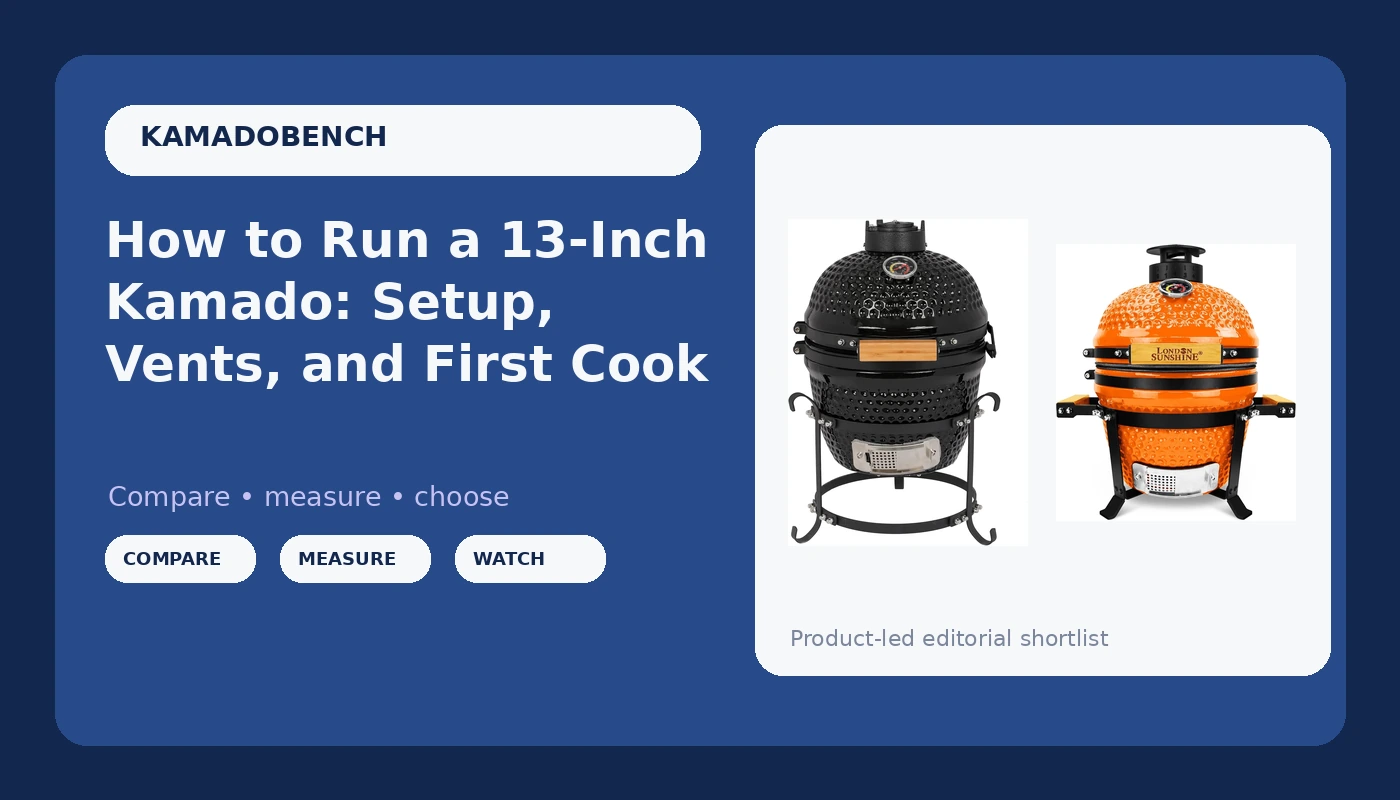
A 13-inch kamado grill is the smallest cooker that still behaves like a kamado: a sealed firebox, a vent you can trim, and a heavy lid that traps heat around the food instead of letting it drift off into the yard. It is not a brisket machine, and it never will be. What it is: a weeknight steak cooker, a tailgate chicken cooker, and the only kamado most people can pick up and move without help.
I have cooked on six kamados over the last three years, two briskets a week, every week, all year, in Savannah. That is enough time to learn what the small ones do well and where they fall on their face. The short version is that a 13-inch kamado is the cooker you actually light on a Tuesday, and if you set it up right it will hold 250 degrees as steadily as a cooker four times its size. The long version is everything below.
Why you should trust me
I have been cooking competition barbecue for 18 years. My backyard test kitchen runs two briskets a week, all year, and I keep a digital thermometer collection that looks like a bomb squad's tool kit. I spent three years and six kamados figuring out which ones hold temperature through a Georgia thunderstorm and which ones turn a good brisket into charcoal.
I do not care about the badge on the lid. I care about whether the ceramic is thick enough to matter, whether the gasket survives a season, and whether the firebox cracks on the first cold snap and whether the warranty replaces it without a notarized confession. Those things decide whether a cooker earns patio space.
What I check before I recommend a small kamado
A 13-inch kamado is not a shrunken 22-inch kamado. The physics change. There is less ceramic mass, so a small cooker comes up to temperature faster and loses it faster too. That makes it more responsive and less forgiving at the same time, and it changes the checklist.
Lid fit and gasket. Run a finger around the lid seam before you cook anything, then do the dollar bill test: close a bill in the gasket, tug it, and it should drag. If it slides out without resistance, air is leaking, and a leaking gasket means your vent settings will never repeat from one cook to the next.
Ceramic thickness at the rim. Thick walls hold heat and shrug off temperature swings. Thin walls give you a cooker that spikes the moment a breeze hits it.
The vent cap. This is the part that fails first. A cheap daisy wheel rusts, seizes, and lets rain run straight into the firebox. A waterproof cap is not a marketing bullet point. It is the difference between a cooker that lives outside and a cooker that cracks.
The firebox. It will crack eventually. The only question is when, and whether the warranty replaces it without a fight. Read that part of the listing before you buy, not after.
Weight and the stand. A 13-inch kamado should be a one-person lift. If it takes two people and a dolly, you bought a small cooker with big-cooker problems.
The two 13-inch kamados worth your attention
Here is where I would start, depending on whether you want portability or real ceramic.
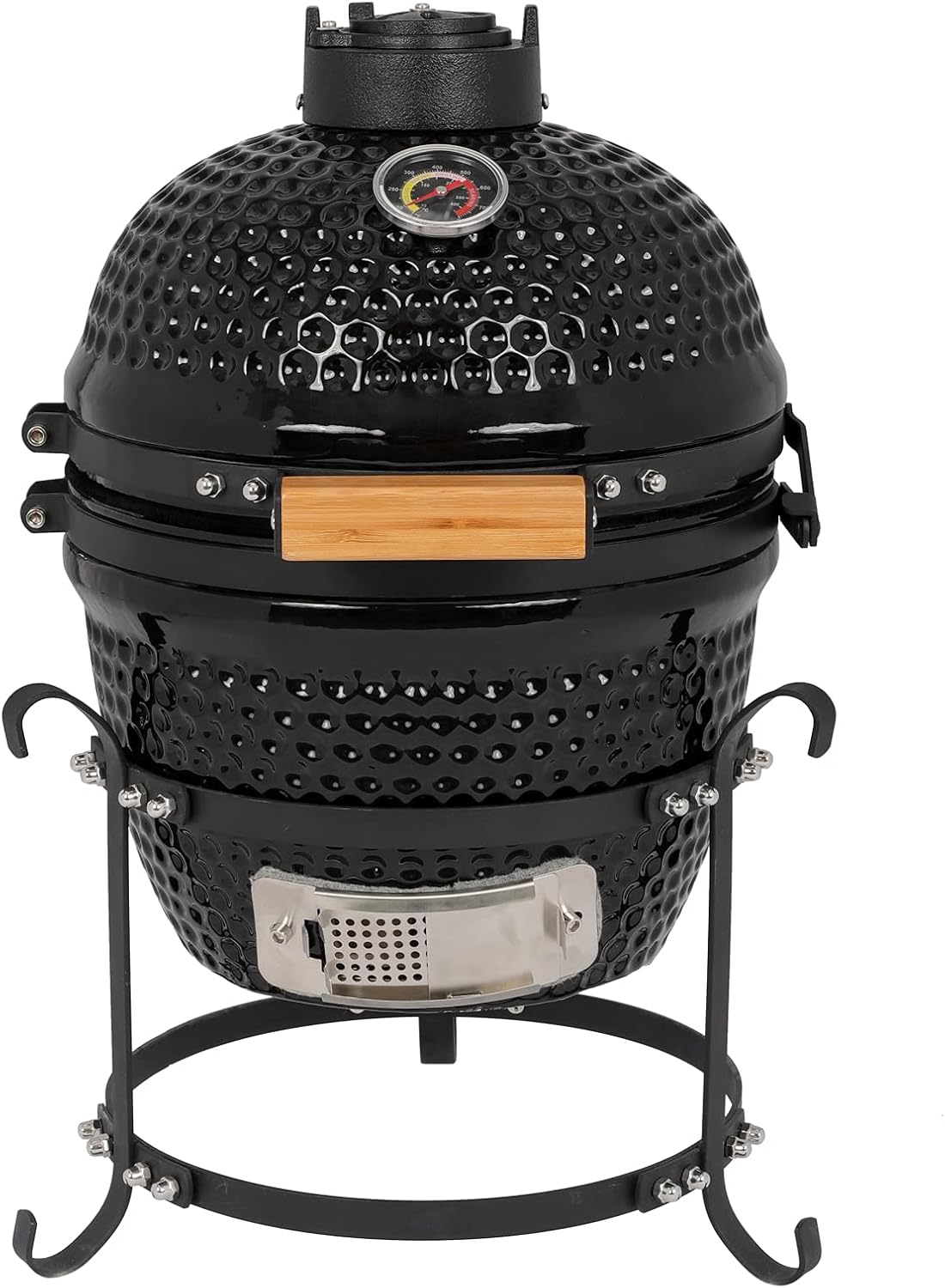
Budget pick: VINGLI 13" Kamado Charcoal Grill Portable Barbecue Grill BBQ Kettle Stand Lid Perfect for Outdoor Camping Patio Backyard Picnic
 Visit on Amazon →
This is the tailgate and campsite answer. The listing describes a 13-inch charcoal cooker with a lid and a stand, so you get the kamado shape and lid-down cooking without hauling a ceramic shell around. What that buys you is speed. A small cooker like this comes up to temperature quickly, which is exactly what you want when you are cooking four burgers on a Tuesday and do not feel like waiting 45 minutes for a full heat soak.
Because this sits at the budget end of the category, spend your first ten minutes with it checking the two parts that decide everything on a small kamado: the lid seam and the vent. Do the dollar bill test before the first fire, season the grate, and learn where your vents land at 350 degrees. Then it becomes the cooker you reach for when you do not want a production.
Flaws but not dealbreakers: A portable cooker at this size will not hold a 12-hour cook the way a thick ceramic will. Treat it as a hot-and-fast machine and it will not disappoint you.
Anyone who wants a one-hand-lift cooker for camping, tailgating, or a small patio should start here.
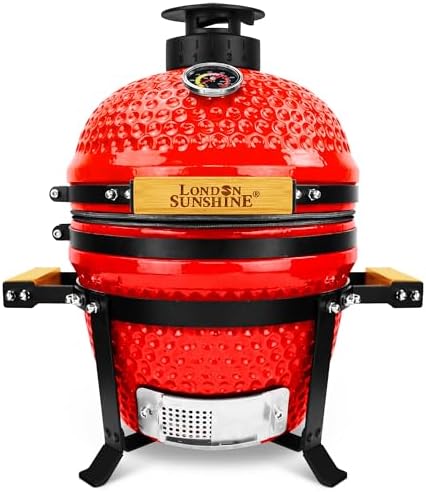
Our pick: London Sunshine 13-Inch Ceramic Kamado Grill, Waterproof Vent Cap, Orange
 Visit on Amazon →
This is the one that is actually ceramic, and ceramic is the entire point of a kamado. Ceramic is the insulation. It is what lets a cooker hold 250 degrees for hours while the outside of the dome stays merely warm, and it is what makes a kamado behave differently from a kettle.
The detail I care about most in the listing is the waterproof vent cap. Rainwater running down the top vent is how small ceramics die, and a cap that seals keeps the firebox dry between cooks. If you plan to leave the cooker sitting outside on a patio, that one feature is worth more than any decal on the lid.
Orange is the finish, which makes it easy to spot from the deck and easy to find when the yard gets crowded with gear.
Flaws but not dealbreakers: Ceramic weighs more than a portable shell, so this is a patio cooker more than a backpack cooker. That is the trade you make for temperature stability.
Anyone who wants the real kamado experience in a small footprint, and who will leave it set up outside, should look here first.
Setting up a 13-inch kamado for the first time
Step one: inspect before you build. Unbox on a soft surface, because ceramic chips. Look for cracks at the rim and around the firebox, and check that the lid sits flush before you tighten anything.
Step two: seat the gasket and align the lid. Do the dollar bill test all the way around the seam. If the bill slides free at one spot, adjust the band or hinge on that side and test again. Five minutes here saves you a season of chasing temperatures.
Step three: the burn-in. The first fire is a seasoning fire, no food on the grate. Bring it up slowly and hold it around 350 degrees for about an hour to burn off manufacturing oils and let the gasket settle. Never ramp a ceramic kamado hard on the first fire. A fast climb is how you crack a firebox.
Step four: load the charcoal. Lump charcoal only. Briquettes throw more ash, and in a 13-inch firebox ash is the enemy because it chokes airflow through the bottom vent. Fill to the firebox rim for a long cook, and use less for a hot, fast cook.
Step five: light it in the middle. A chimney starter, or one fire starter buried in the middle of the pile. Bottom vent wide open, lid open, until the center coals are gray at the edges. Then close the lid.
Step six: heat soak. This is the step everyone skips, and it is the step that decides whether dinner works. Set your vents for roughly where you think the target is, close the lid, and let the cooker sit for 30 to 45 minutes. A kamado needs that time for the ceramic to absorb heat and for the temperature to stop climbing. Put food on a kamado that is still climbing and you will spend the next two hours chasing the needle.
The vent settings that hold 250 degrees
Two vents, two jobs. The bottom vent is the throttle. The top vent is the fine trim. Learn that and you have learned 90 percent of kamado cooking.
A workable starting point for a 13-inch cooker:
- 225 to 250 degrees: bottom vent open about a finger's width, top daisy wheel open a sliver. Wait 15 minutes before you touch anything.
- 300 to 350 degrees: bottom vent open a couple of fingers, top wheel open a quarter.
- 400 to 450 degrees for steak: bottom vent half open, top wheel wide. Sear with the lid cracked if you want char.
- 500 and up: both vents wide, and do not walk away. Small ceramics get to 500 fast, and the gasket is the first thing to complain.
The rule that matters more than any number: make one adjustment, then wait 10 to 15 minutes before making another. Kamados respond slowly, and the cook who chases the temperature with constant vent fiddling is the cook who overshoots by 75 degrees and burns the rub.
If you overshoot, do not slam both vents shut. Close the bottom vent partway and let the temperature drift down on its own. Cutting all the air on a hot ceramic can crack it and can leave unburned fuel smoldering in the firebox.
What actually fits on a 13-inch kamado
Be honest about the size. A 13-inch grate is a two-zone cooker for two people, not a party machine.
What fits comfortably: two ribeyes, four burgers, a spatchcock chicken, a whole chicken over a heat deflector, a small pork butt, a rack of ribs if you curl it or use a rib rack, a couple of ears of corn, a cast iron skillet of beans.
What does not fit: a full packer brisket, two racks of ribs laid flat, a turkey, a pork shoulder for a crowd. Those are 22-inch jobs.
For low and slow on a small kamado, put a heat deflector between the fire and the grate, and expect a smaller fuel load to mean a shorter cook. A small pork butt is a realistic overnight cook on a 13-inch ceramic. A 14-pound brisket is not.
Shutting down and keeping it alive
When dinner is done, close the top vent and the bottom vent all the way and walk away. The fire chokes out in about 30 minutes, and whatever lump is left is reusable next time. That leftover fuel is one of the quiet advantages of a kamado, and it is why the cost per cook on a small one is lower than it looks.
Maintenance on a 13-inch kamado is a short list: empty the ash before it builds up to the vent holes, check the gasket seam every few cooks, keep the vent cap seated so water stays out, and cover the cooker if it lives outside. Replace the gasket when it stops dragging on the dollar bill test. That is the whole job.
What this all costs
I am not going to quote prices here, because they move. Check current Amazon price on both of the cookers above before you decide.
What I will tell you is how to think about the money. A small kamado is cheap to run because lump charcoal is reusable once you shut the vents, and a 13-inch firebox does not need a full bag for a weeknight cook. The real cost of a small kamado is the cost of buying the wrong one. A cooker with a thin gasket and a rusted vent cap will have you replacing parts, or replacing the whole thing, inside two seasons. That is the expensive path.
What I left off this list
The 22-inch and 24-inch kamados, which is a different article. A Kamado Joe Classic, a Big Green Egg, a Char-Griller, a Vision, a Pit Boss: those are the cookers you buy when you are feeding a crowd or chasing a packer brisket, and the math changes completely at that size. If you are here because you want to smoke a full brisket every weekend, you want a big ceramic, not a small one. If you want a cooker you will genuinely light on a weeknight, a 13-inch kamado is the right answer.
Quick answers
How long does a 13-inch kamado take to heat soak? Thirty to 45 minutes with the lid closed after the coals catch. The smaller ceramic mass means it stabilizes faster than a 22-inch cooker, but it also swings faster, so give it the time.
Can you smoke a brisket on a 13-inch kamado? Not a full packer. A brisket flat, a small pork butt, or a chicken are all realistic. If the meat does not fit with an inch of clearance on every side, the airflow is wrong and the cook will run hot.
Do you need a temperature controller on a small kamado? No. Learn the vents first, because that is the skill that transfers to every cooker you will ever own. A controller earns its place for overnight cooks, once you already know what the vents should be doing.
That is the whole process. Inspect the lid seam, burn it in slow, learn where 250 lives on your vents, and give the ceramic its heat soak. Do that and a 13-inch kamado will out-cook cookers three times its size on a Tuesday night. The size is the limit. The temperature control is the job.