
A kamado grill cover is the cheapest insurance a ceramic cooker gets, and it is also the piece of gear people use wrong. I see it every October in Savannah. Somebody throws a cover over a dome that is still warm, cinches it down, and leaves it there for three weeks while the humidity works on the gasket.
I have been cooking competition barbecue for 18 years, and my backyard test kitchen runs two briskets a week, every week, all year. In that time I have replaced more gaskets than thermometers, and nearly every failure traced back to how the cooker was stored, not how it was cooked.
The routine below takes about 15 minutes after a cook, and it is the difference between a kamado that runs a clean 250 for 12 hours and one that leaks air at the hinge. Same cooker. Different habits.
Why you should trust me
I have cooked on everything from a rusty offset to a top-shelf ceramic egg, and I have spent years finding out which kamados hold temperature through a Georgia thunderstorm and which ones turn a brisket into charcoal. My whole worldview fits in one sentence: a kamado's job is holding temperature, and everything else is marketing.
That means I care about the boring stuff. Ceramic thickness. Gasket condition. Vent control. The firebox that will crack eventually and whether the warranty replaces it without a fight. Storage sits right at the top of that list, because a cooker that lives under a wet cover all winter is a cooker that will not hold temperature in April.
How I judge gear like this
Two categories, two different sets of questions.
For a cover, I look at four things. Does it shed water or soak it? Does it cinch so wind cannot turn it into a sail? Does the inside dry out between storms? And does it fit the dome without stretching or pooling at the hinge? A cover that pools water right at the hinge is worse than no cover at all, because that is exactly where the gasket lives.
For flat-top tools, the questions are about heat and rust. Do the handles stay tight after a season of scraping? Does the basting cover sit flat so steam actually traps instead of escaping around the rim? Does the burger press survive being set down on a hot surface while you are juggling buns? Any tool that rusts in a drawer is a tool I stop reaching for.
I also read the warranty fine print, and I check whether replacement parts exist. You are buying a routine here, not a one-time purchase, so the gear has to survive being used on a Tuesday.
The cover you want on the dome before the weather turns
This is the first thing I buy for any new ceramic cooker, and it is the last thing most people think about.
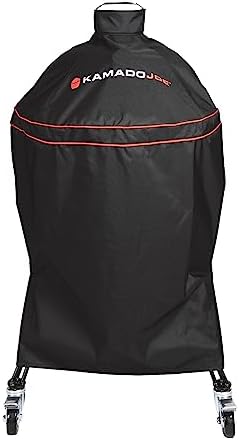
Our pick: Kamado Joe Classic Joe Series 18-inch Ceramic Charcoal Grill and Smoker Cover with Adjustable Buckle in Black
 Visit on Amazon →
The Kamado Joe Classic Joe cover is the one I point people to when they own an 18-inch Classic Joe, because it is cut for that dome rather than cut "close enough." It is a polyester cover with an adjustable buckle, and that buckle matters more than it sounds. A cover without a cinch is a kite. In a Savannah storm, a loose cover lifts, flaps against the hinge, and lets rain run straight down into the top vent.
Check current Amazon price before you order, and confirm your model first. If you own a Classic Joe, this is the shape you want.
Fit is the whole point with a kamado. The dome is round and the hinge is exposed, so a generic rectangular cover leaves gaps at exactly the wrong place. A cover made for the 18-inch Classic Joe drapes over the dome, the hinge, and the side shelf area without stretching. The polyester weave also breathes a little, which matters in humid country. A cover that seals completely will hold condensation against the ceramic all winter, and condensation is what kills gaskets and puts surface rust on steel bands.
Flaws but not dealbreakers: It is a cover, not a case. It keeps rain, pollen, and pine straw off the cooker. It will not protect the dome from a falling limb, and no cover will. If you park your kamado under a live oak, deal with the branch before storm season, not the cover.
Anyone who cooks year round and wants to stop scrubbing pollen off the dome every Saturday should own one of these.
The flat-top tools that earn their drawer space
A kamado runs low and slow for 12 hours. A flat top runs hot and fast for 20 minutes. If you own both, you already know they cover each other's weaknesses, which is why the tools for the second one deserve the same care as the first.
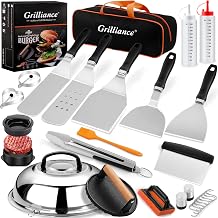
Our pick: Grilliance 27pcs Griddle Accessories Kit, Professional Hibachi Flat Top Grill Tools, Enlarged Spatula Gift Set with Basting Cover, Burger Press Patty Maker for Outdoor BBQ Teppanyaki
 Visit on Amazon →
The Grilliance kit covers the jobs that a flat top actually asks for. There is an enlarged spatula for flipping and scraping, a basting cover for trapping steam over cheese and onions, and a burger press for patties that cook evenly instead of doming in the middle. Twenty-seven pieces sounds like a lot until you are mid-cook with a crowd standing around, and then it sounds about right.
Check current Amazon price, because this is the kind of kit that sells out around gift season.
Here is why it belongs in a between-cooks article. Flat-top tools live or die on maintenance. A spatula you scrape a hot griddle with, then leave sitting in the grease trough overnight, is a spatula with a loose handle by August. The basting cover collects grease on the inside and rusts at the rim if you stack it wet. The press is the worst offender, because patty residue gets into the seams and stays there. None of that is a defect. All of it is storage and cleanup.
Flaws but not dealbreakers: Twenty-seven pieces means 27 things to keep track of and dry. Leave them loose in a damp garage and the pieces you use least will spot with rust before you ever reach for them. That is a storage problem, and one dry tote fixes it.
Anyone running a flat top alongside a kamado will get more use out of this kit than out of half the gadgets in their drawer.
The between-cooks routine, step by step
Now the part you came for. This works on any ceramic cooker with a gasket and any flat top with a steel surface. The order matters.
Step one: Burn it out, then shut it down. When the cook is done, let the remaining fuel burn down instead of dumping it. Then close the top vent and the bottom vent and let the fire snuff itself. Do not spray water in the firebox. Thermal shock is how you crack ceramic, and a cracked firebox is a warranty conversation you do not want to have on a Sunday.
Step two: Wait for the ceramic to cool. This is the step people skip. Ceramic holds heat for hours. Wait until the outside of the dome is cool to the touch, which is usually two hours after a long cook and longer after a brisket. Covering a warm dome traps moisture against the ceramic and the gasket. That trapped moisture is what makes a gasket peel and fail by spring, and a failed gasket means your temperature control fails with it.
Step three: Empty the ash. Pull the ash out while the cooker is cool. Ash plus Savannah humidity sets like mortar, and a firebox packed with damp ash will not draw air the way it should on your next cook. Empty it every few cooks, not once a season.
Step four: Inspect the gasket before you cover anything. Run your hand around the lid seal. If it is lifting at a corner or feels brittle, fix it now, while the weather is decent and you are not trying to hold 250 through a rainstorm. Gaskets that peel in a season are one of my genuine pet peeves, and the ones that fail fastest are the ones stored wet.
Step five: Wipe the dome dry. Never cover a wet cooker. If it rained, or if you just cleaned the outside, give it time to dry in the sun before the cover goes on. This is the single most common mistake I see.
Step six: Fit the cover and cinch the buckle. Set the cover over the dome so it hangs evenly, then reach under and tighten the adjustable buckle so the fabric hugs the belly of the cooker. A snug cover does not flap, and a cover that does not flap does not wear through at the hinge.
Step seven: Check it monthly. On a dry, sunny day, lift the cover for 20 minutes and let the cooker breathe. If you find condensation on the inside of the cover, you covered it too soon or too wet. If you find pine straw and pollen, that is the cover doing its job.
Step eight: Scrape the flat top while it is still warm. Warm is the key word. Once a griddle surface goes cold, everything on it turns to glue. Scrape it down, wipe it with a thin coat of oil, and let it cool with that film on it. That film is the seasoning, and the seasoning is the rust protection.
Step nine: Clean the basting cover and the press. Wash both, dry them completely, and put a light coat of oil on the steel. Water sitting in the rim of a basting cover overnight is how you get a rust ring by morning. Dry means dry, not towel-damp.
Step ten: Store the kit dry, not on the shelf. The single best upgrade to a flat-top setup is a lidded tote that lives indoors. Tools that stay dry do not rust, and tools that do not rust are tools you actually use.
Where people get this wrong
Three mistakes cover most of it.
The first is covering a hot or warm cooker. You are not protecting anything by getting the cover on early. You are steaming the gasket and the steel bands.
The second is treating the vents as an afterthought. For storage, close both vents so rain and insects stay out, but do not crank them shut with gorilla force. You want the seal, not a stripped vent.
The third is storing flat-top tools outdoors uncovered. A kamado shrugs off weather. A carbon steel spatula does not. The cooker is the investment, and the tools are the cheap part, which is exactly why people neglect them and then complain that everything they own rusts.
Gear that did not make this guide
This article is about care, not about which kamado to buy, so the rest of the field stays out of it. Big Green Egg is the benchmark and the ceramic is superb, but the cover question is the same for an egg as it is for anything else. Char-Griller's kamado is the best budget entry and Vision Grills makes a solid mid-tier cooker with a metal exterior, and both still want the same shutdown routine.
Those comparisons belong in a buying guide. Today is the storage guide.
What this routine costs you
No dollar figures, because the math here is time, not money. Fifteen minutes after each cook. Two hours of waiting for the ceramic to cool, which costs you nothing because you are not standing there watching it. One dry day a month to lift the cover and let the cooker breathe. A few minutes at the sink for the flat-top tools.
Stack that against a gasket replacement, a firebox swap, or a rusted-out tool kit, and the routine pays for itself the first time you avoid one of them. The cooker is the expensive part. The habits are free.
Do it once, do it every time, and your kamado will still hold temperature on a Tuesday in February. That is the whole job.